

When the Municipality of Tetovo plans to build a school, reconstruct a street, build a sewage system or invest in a sports facility, the funds go through public procurement procedures. For citizens, these procedures often seem complex, with documents, tables, values and technical terms.
But, in essence, the question is simple: How much money is planned, what will be purchased, who will implement it and how much does the contract cost?
The Municipality of Tetovo has a separate public procurement unit, which, among other things, prepares the annual public procurement plan, tender documentation and contracts and monitors the implementation of orders in accordance with the concluded contracts. The financial structure of the Municipality also provides for control of the implementation of contracts and checking of financial documentation, including invoices, orders, shipping documents and receipt documents.
This means that public procurement does not end with the announcement of the selected company. The process continues with the implementation of the contract and financial control of what has been purchased or built.
From budget to contract
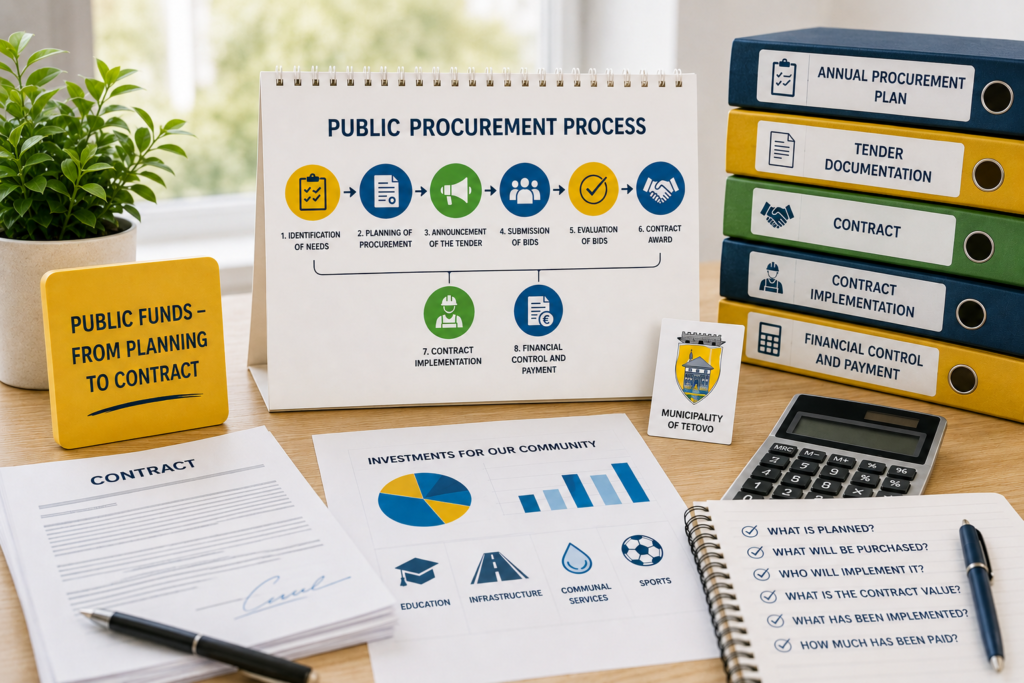
Simply put, a public procurement can be monitored through several steps: the need is identified, it is planned within the framework of public procurement, the procedure is announced, companies submit bids, a selection is made and then a contract is concluded.
It is important for the citizen to distinguish between several types of amounts. One document may show the estimated value of the procurement, another the company’s bid, and another the value of the signed contract. These amounts should not automatically be treated as the same thing.
Equally important is the difference between the value of the contract and the amount actually paid. If the contract has a certain value, this does not mean that the entire amount has been paid at the moment the contract is signed.
That is why, when analyzing public funds, not only contracts should be monitored, but also their implementation.
Contract of 155 million denars for the “Goce Stojchevski” school
One of the high-value contracts that the Municipality of Tetovo concluded in 2025 is the contract for the construction of the building of the “Goce Stojchevski” primary school, second phase.
According to published data from November 26, 2025, the Municipality of Tetovo concluded a contract with the company AK Invest DOOEL Tetovo worth 155,209,095 denars, which in the published source is stated as 2,523,725 euros.
This is a specific concluded contract, and not just an estimated amount stated in the public procurement plan.
However, in this case, too, a distinction should be made: the amount of 155,209,095 denars is the published value of the contract, and not automatically the amount that we can say that the Municipality has already paid.
Over 130 million denars for the Lisec-Popova Shapka road
Another significant contract concerns the construction of the secondary road, i.e. the Lisec-Popova Shapka road connection.
According to data published on November 20, 2025, the Municipality of Tetovo concluded a contract with the company Pelagonija AD Gostivar worth 130,160,255 denars, which is stated in the same source as 2,116,427 euros.
And in this case, it is about the value of the contract. In order to determine how much was actually paid by a certain date, financial data for the implementation of the contract is needed.
Investments in sports facilities
In 2025, the Municipality of Tetovo also concluded contracts for the construction of sports facilities in schools.
On November 17, 2025, it was announced that the Municipality had concluded a contract with the company Vivint DOOEL Skopje for the construction of a sports hall and an indoor swimming pool in the Primary School “Naim Frasheri”. The value of the contract is 61,117,971 denars, or 993,788 euros, according to the published source.
A contract with the same value, 61,117,971 denars, was also concluded with the company Eurovia DOOEL Zelino for the program for the construction of a sports hall and an indoor swimming pool in the Primary School “Kiril i Metodij”.
Thus, these two contracts for sports facilities alone represent a total nominal value of 122,235,942 denars.
Four contracts, over 408 million denars
If we add up just the four contracts listed above – the building of the primary school “Goce Stojchevski”, the Lisec–Popova Shapka road and the two contracts for sports facilities – the nominal value of the contracts is: 408,605,094 denars.
This amount is a mathematical sum of the published values of the four contracts and should not be presented as an amount that the Municipality has already paid.
This is an important point when reading public procurement. When a contract is concluded for 100 million denars, this shows us the value of the contract. In order to say that “the Municipality spent 100 million denars”, we need to have proof of the corresponding payments made.
What do the company data show?
An analysis published by the Public Procurement Bureau in its 2025 report shows that certain economic operators received a significant share of public procurement contracts in the Municipality of Tetovo.
The report lists, among others, Pelagonija AD Gostivar, with contracts worth 206,382,336 denars, AK Invest DOOEL Tetovo, with 155,209,095 denars, as well as Eko-Peu DOOEL Tetovo, with 112,585,905 denars. The report also shows the total value of contracts concluded with the analyzed economic operators.
This data is significant because it comes from an institutional source and does not show just one tender, but a broader picture of public procurement contracts.
However, the fact that a company received multiple contracts or a high total value of contracts does not in itself mean that there were irregularities. For such a conclusion, each procedure, the number of bidders, the selection criteria, the contract and the method of implementation should be analyzed.
Why is it important to distinguish between a contract and a payment?
For a citizen, one of the easiest mistakes is to see a certain amount in a tender and automatically consider it as spent funds.
But a contract can have a value of 155 million denars, while payments can be made in stages, according to the implementation of the works and the terms of the contract.
Therefore, a serious analysis of public expenditures should try to follow the entire chain: how much was planned, what was the value of the tender, who won, what was the value of the contract, what was implemented and how much was paid.
The Municipality of Tetovo publishes documents related to the budget, public procurement contracts and the annual public procurement plan on its website. The official website also describes the responsibilities of the financial and public procurement units in the preparation, control and monitoring of the implementation of these procedures.
What can a citizen check?
To understand a public expenditure, a citizen does not have to be an expert in public procurement. He can start with a few basic questions: What is being purchased or built? What is the estimated value? What is the value of the contract? Who won the contract? How many companies competed? What is stipulated in the contract? When should the work be completed? And, most importantly, has what was paid been realized?
These questions make it easier to read public documents.
In the case of the Municipality of Tetovo, published data for 2025 show that public procurement includes large projects in education, infrastructure and sports. The four contracts analyzed in this article alone have a combined value of over 408 million denars.
But the number itself does not indicate whether the funds were used well. This requires another step: verification of implementation.
Transparency begins when citizens can track the money
A transparent public procurement system should not only enable the retrieval of a contract. It should enable citizens to track the history of a public expenditure from beginning to end.
From the moment a need is entered into the plan, through the announcement of the tender, the offers of companies, the selection of the winner and the signing of the contract, all the way to the implementation and payment.
In this way, the administrative document becomes information that citizens can understand and use.
In the end, the most important question is not just “How much money is planned?” The question is: “What has been realized with this money?”
For the citizens of Tetovo, the answer to this question is essential for understanding how the municipal budget is used and what concrete benefits citizens receive from public expenditure.
Sources:
- Municipality of Tetovo – documents on the budget, contracts and annual public procurement plan.
- Municipality of Tetovo – structure and responsibilities of the financial and public procurement units.
- Public Procurement Bureau – public procurement report: data on concluded contracts and economic operators, including Pelagonija, AK Invest and Eco-Peu.
- eMagazin – the contract for the “Goce Stojchevski” Primary School: data on the contract of 155,209,095 denars with AK Invest.
- eMagazine – the Lisec-Popova Shapka agreement: data on the agreement of 130,160,255 denars with Pelagonija AD Gostivar.
- eMagazin – the contract for the “Naim Frasheri” Primary School: data on the contract of 61,117,971 denars with Vivint.
- eMagazin – the contract for the “Cyril and Methodius” Primary School: data on the contract of 61,117,971 denars with Eurovia.
Author: Angel Stojanovski

This activity is supported by the CIVICUS Digital Democracy Initiative (DDI)