
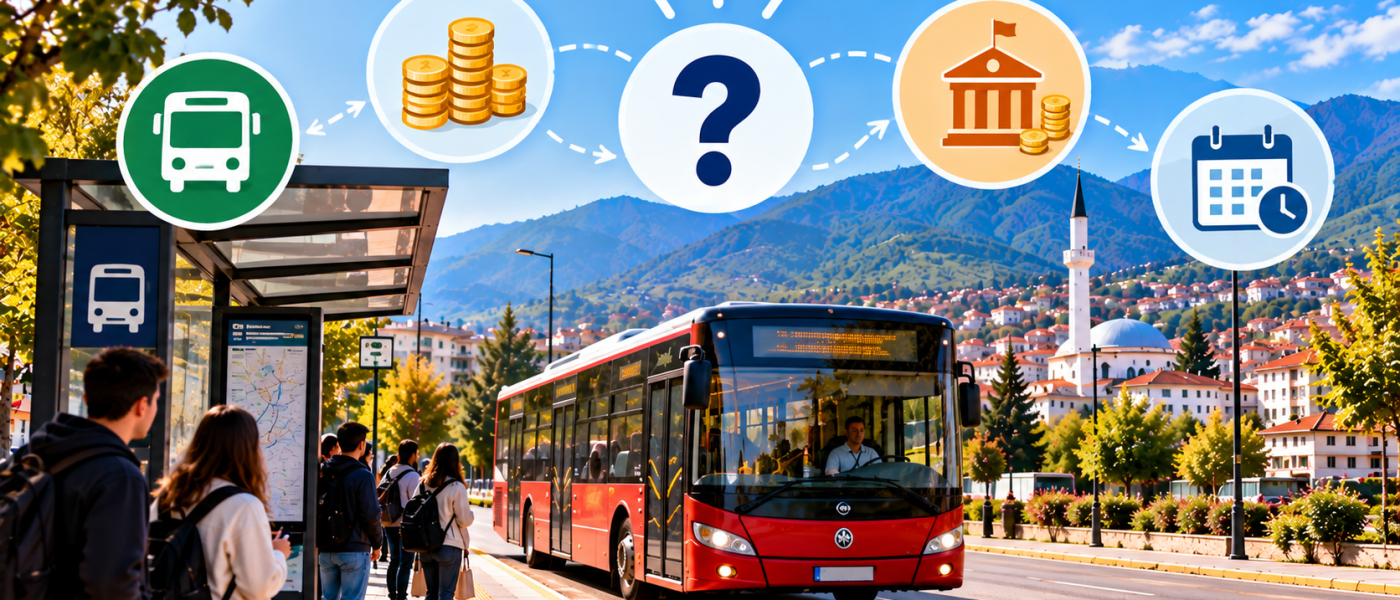

Public transport is one of the services that citizens use every day. However, besides the question of when the bus will arrive, there is another important question: how much does public transport cost the city, and who pays for it?
In Tetovo, urban transport is organised by the Public Enterprise “Tetovо Transport”, while the Municipality of Tetovo covers part of the costs through subsidies. For 2026, the Council of the Municipality of Tetovo approved a new subsidy model that provides up to 18 million denars, or approximately EUR 293,000, for the operation of public transport. The official decision on subsidising “Tetova Transport” for 2026 shows how the service is planned to be financed.
According to the Municipality of Tetovo’s decision on the subsidy, the Municipality does not pay the enterprise a fixed monthly amount. Instead, the subsidy is calculated based on the kilometres travelled by buses during the month. The Municipality provides 150 denars per kilometre travelled, while the total amount for the year cannot exceed 18 million denars. This means that funding from the municipal budget is directly linked to the operation of the routes and the kilometres covered. The decision stipulates that these funds will be provided from the Municipality of Tetovo’s 2026 budget.
However, this amount should not be confused with the total costs of public transport. 18 million denars is the maximum municipal subsidy, not the total expenditure of “Tetovo Transport”. The enterprise’s expenses include salaries and employee contributions, fuel, bus maintenance and repairs, spare parts, insurance, and other operating costs. The Municipality’s 2026 decision justifies the subsidy by referring to the increase in the minimum wage and the high prices of oil and petroleum products. It also warns that without financial support, there is a risk of reducing the number of routes and daily departures.
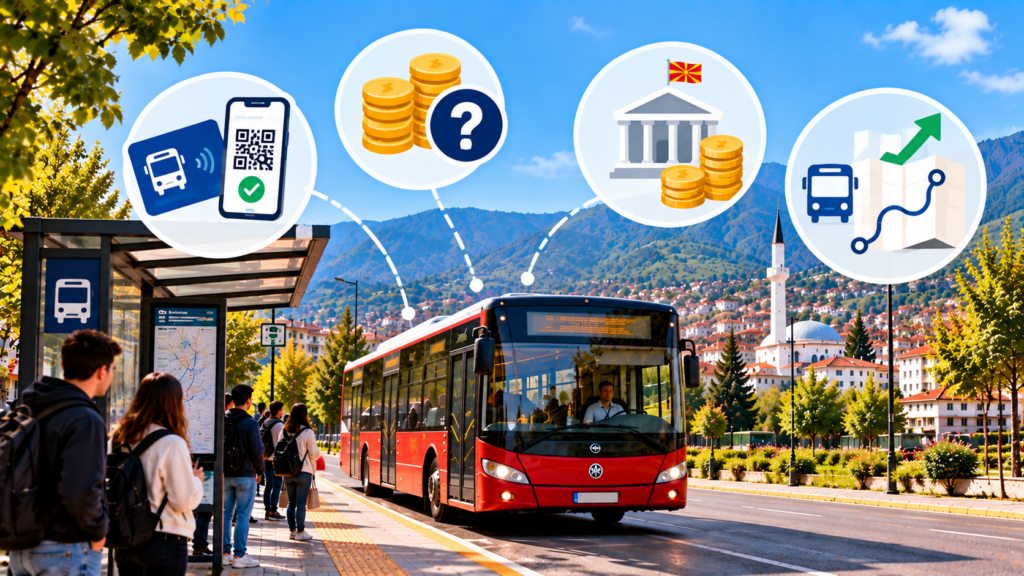
When it comes to revenue, it is important to make a distinction: revenue from ticket sales does not go directly to the Municipality of Tetovo; it belongs to the Public Enterprise “Tetovo Transport”. During the period when transport operated on a paid basis, ticket revenue was insufficient to cover all expenses. In November 2025, it was reported that ticket sales covered approximately 30 per cent of the costs, while the remainder had to be covered by the municipal budget. This was one of the reasons for introducing free public transport, as reported in the article on the financing model and free public transport.
The model changed in 2026. The Municipality and “Tetovo Transport” introduced a free public transport system for citizens who have settled their obligations to the Municipality, while the new system uses cards and a digital application. According to information on the new ticketing system and free transport, citizens can apply through the TE KLIK application, while RFID cards and digital tickets with QR codes are also planned. This means that the previous model, in which the enterprise partly depended on ticket sales, is gradually being replaced by a model in which a larger share of the costs is covered through public funds.
How many buses does Tetovo have?
Public transport began with five buses, purchased through the Municipal Services Improvement Project, with financial support linked to the World Bank. The initial investment was planned at 72.6 million denars, while the buses were procured for 44.3 million denars, equivalent to approximately EUR 720,000. More information is available in the Ministry of Finance’s announcement about the investment in Tetovo’s buses.
Data published in 2025 also described the “Tetovo Transport” fleet as consisting of five buses. At that time, urban transport operated on four routes, while a route to Popova Shapka was also available during the winter season, according to information on Tetovo’s bus routes and fleet.
For citizens, one of the biggest problems is not just the number of buses, but also knowing where a bus is and when it will arrive. Digital tools already exist to help address this issue. The “GoPublicTransport” application, developed by two young people from Tetovo, gathers information about the routes and timetables of “Tetovo Transport” and allows users to view routes, stops, and schedules. The application was created specifically to make public transport information more accessible to citizens, as explained in the article about GoPublicTransport.
However, there is a difference between the planned timetable and the actual location of a bus. The creators of GoPublicTransport have proposed further developing the system to enable real-time tracking by connecting the buses’ GPS systems to the application. According to them, such a system would allow citizens to see the location of a bus on a map and how much time remains until its arrival. At present, an official public system for tracking buses in real time has not been confirmed in the official sources we reviewed; the proposal is described further in the source on GoPublicTransport.
There is also the NOTaxi application, which provides bus timetable information for Tetovo, alongside other transport-related services. The application is available for Android and iOS and provides information about bus schedules in Tetovo. However, this does not mean that it displays the GPS locations of buses in real time. Users can check the available information through NOTaxi on Google Play and NOTaxi on the App Store.
Regarding routes, the urban network has expanded since public transport was first introduced. Data published in 2025 show four main routes: Route 1, Route 1/A, Route 2, and Route 3, connecting different parts of the city and surrounding settlements. During the winter season, transport is also available on the Tetovo-Popova Shapka route. In January 2026, the Municipality published a timetable for this route, with departures from Tetovo at 08:00 and 10:00 and return journeys at 14:45 and 16:00. Details are available in the information on the Tetovo–Popova Shapka route.
But the most interesting question for the future is whether Tetovo will have more buses. A publicly announced plan exists. The Municipality announced that Tetovo has been included in a plan to provide five new electric buses, and an expansion of public transport to rural areas and mountain villages has also been announced. The same plans mention the procurement of four minibuses to serve the villages in the Sharr Mountains, according to the report on the electric buses and the expansion of transport services.
So far, it can be confirmed that the five electric buses are planned, but we have not found an official document specifying an exact delivery date. It is therefore important to distinguish between an announced investment and buses that have already been purchased and put into service. Without an official delivery announcement, it would be inaccurate to state that the fleet has already increased from five to ten buses.
Development of a Sustainable Urban Mobility Plan for the City of Tetovo
Another important change concerns mobility planning. The Municipality’s 2026 programme includes the development of a Sustainable Urban Mobility Plan for the City of Tetovo, with a planned value of 7.4 million denars. This plan is important because mobility is not only about buses, but also about how public transport, roads, pedestrian and cycling paths, parking, and traffic will be organised in the future. This measure is included in the programme and documents of the Municipality of Tetovo.
The same investment programme for 2026 also provides 2 million denars for the construction of bus stops within the urban network. This shows that investment in public transport is not limited to purchasing buses, but also includes infrastructure that citizens use while waiting for and boarding buses, as stated in the Municipality’s official document.
This raises an important question for citizens: where can we find out how much money has been spent, how many buses are operating, and what is planned for the coming period? Some of this information can be found in the Official Gazette of the Municipality of Tetovo, where decisions on subsidies, public enterprise plans, and budget documents are published. The Municipality also has a dedicated section on traffic and roads, which outlines responsibilities related to urban traffic planning, scheduled passenger transport, bus stations, and traffic analysis.
In this way, public transport in Tetovo can be assessed not only by asking “Has the bus arrived?” but also by considering the bigger picture: how much the service costs, what share is covered by citizens, what share is covered by the Municipality, how many buses are available, which routes operate, how many kilometres are travelled, and which investments are planned.
For 2026, publicly available information indicates a model in which the Municipality has provided for up to 18 million denars in subsidies for “Tetovo Transport”, public transport is free for certain categories of citizens, five new electric buses are planned, expansion to rural and mountainous areas has been announced, and the Municipality is planning investments in bus stops and a broader sustainable urban mobility plan. The next challenge is to ensure that citizens can track not only the plans but also their implementation: how much of the funding has been spent, how many kilometres have been covered, how many buses are actually operating, and when the new buses will enter service.
Ultimately, modern public transport is not measured solely by the number of buses. It is also measured by how easily citizens can find the timetable, see where a bus is, know when it will arrive, understand how much the service costs, and see how public funds are used. For a city like Tetovo, transparency in this information is just as important as the buses themselves travelling through its streets.
Author: Angel Stojanovski

This activity is supported by the CIVICUS Digital Democracy Initiative (DDI)