

Streets, water supply, and sewerage: what has been completed and what is still underway?
Road and utility infrastructure was one of the more visible areas of investment for the Municipality of Tetovo during 2026. Based on municipal announcements, information provided by Mayor Biljal Kasami, official documents, and infrastructure project reports, numerous interventions involving streets, water supply, and sewage systems were recorded throughout the year in both urban and rural areas.
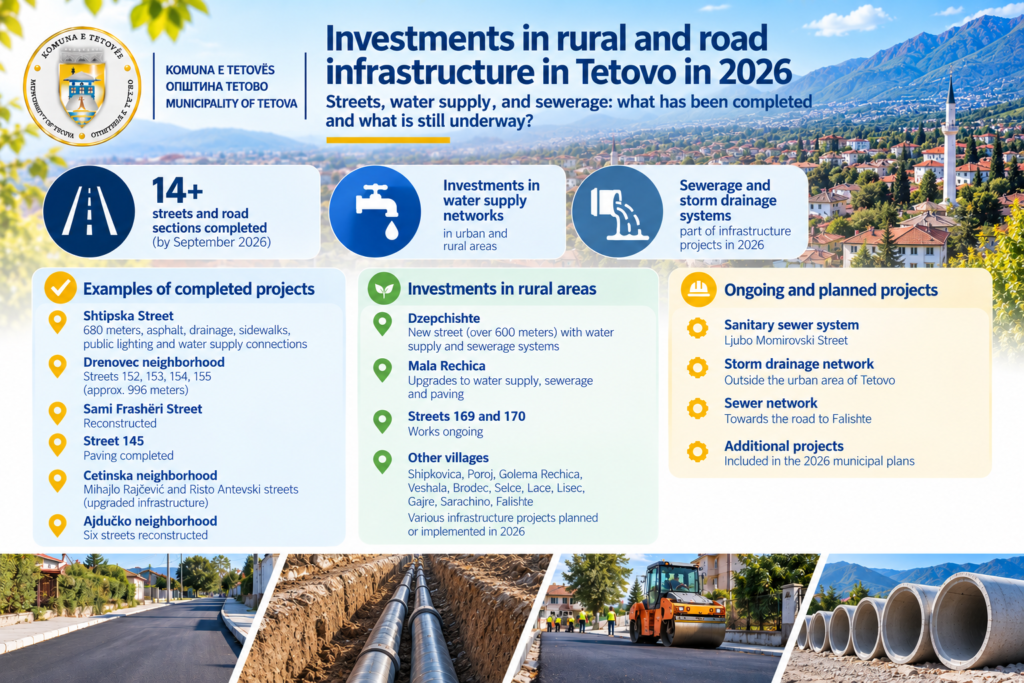
By September 2026, at least 14 streets or road sections could be documented as completed or promoted as such. This figure should not be considered the final tally of all work carried out during the year, as some projects are still underway and final budget execution data is published only after the year concludes.
Completed Projects
One of the significant projects is the reconstruction of “Shtipska” Street. The project covered a 680-meter stretch and included asphalt paving, storm drainage, sidewalks, public lighting, traffic signage, and new connections to the water supply network. The project was implemented with support from the Ministry of Transport and the participation of the Municipality of Tetovo.
In the Drenovec neighborhood, work was completed on four streets: “152,” “153,” “154,” and “155.” According to published project data, this involved the reconstruction of approximately 996 meters of roadway.
Another project promoted during the year was the reconstruction of “Sami Frashëri” Street, and the paving of Street “145” was also completed.
In the Cetinska neighborhood, work covered “Mihajlo Rajčević” and “Risto Antevski” streets, including upgrades to underground infrastructure, storm drainage, and the water supply network. It was later announced that the reconstruction of “Mihajlo Rajčević” Street had been completed.
Another major project was carried out in the “Ajdučko” neighborhood, where six streets were reconstructed: “Aleksandar Zdravkovski,” “Železnička,” “Gjoce Simoski,” “Predrag Jančevski,” “Dervish Cara,” and “Street 118.”
These projects demonstrate that a significant portion of investment is directed toward reconstructing existing streets and improving urban infrastructure.
Investments in villages too
Investments were not limited to the city of Tetovo alone.
A new street over 600 meters long was completed in Dzepchishte. In addition to paving, the project included a new water supply network, as well as storm and sanitary sewer systems. Upgrades to the water supply, sewerage, and paving were announced for Mala Rechica, while work on Streets 169 and 170 was part of the infrastructure projects that continued throughout the year.
Infrastructure activities whether planned or already implemented, have also been recorded in other rural settlements, including Shipkovica, Poroj, Dzepchishte, Golema Rechica, Mala Rechica, Veshala, Brodec, Selce, Lace, Lisec, Gajre, Sarachino, and Falishe. Various infrastructure projects for these areas are included in the Municipality’s official planning documents for 2026.
This demonstrates that rural infrastructure is not viewed merely as a matter of paving; specific projects also encompass water supply and both sanitary and storm sewer systems.
Investments in water supply and sewerage
Another important part of the infrastructure is the one not always visible on the surface. The Municipality’s planning documents for 2026 include, among other things, projects for the construction of a sanitary sewer system on “Ljubo Momirovski” Street, a storm drainage network outside the Tetovo urban area, and a sewer network extending toward the road to the village of Falishte. Specific budget allocations for these projects are also outlined in the official documentation.
These investments are crucial because a new or reconstructed street does not constitute a complete infrastructure solution if the underground infrastructure remains outdated or inadequate.
How much is planned to be invested?
In the 2026 budget, the Municipality of Tetovo has planned a significant number of capital investments. In addition to road projects, the programs encompass utility infrastructure, as well as water supply and sewerage systems.
However, it is important to distinguish between planned funds and realized expenditure. The fact that a certain amount is allocated in the budget does not automatically mean that the same amount has been spent or that the project has been completed.
To evaluate an investment, it is necessary to consider the budget, the contract, the public procurement process, the final cost, and the project’s implementation together.
How easy is it for the citizen to follow the process?
This presents a significant challenge regarding transparency. The municipality publishes documents on its official website, including official gazettes, project documentation, and other materials.
However, project budgets, public procurement procedures, contracts, contract amendments, and implementation timelines are not always readily accessible to the public in a simple and understandable format.
For a citizen wishing to check the status of a specific street, it is often necessary to search through multiple documents and various sources to find answers to questions such as: what was originally planned, what was the tender value, which company was awarded the contract, when the project began, when it was scheduled for completion, and what the final cost was.
This is particularly important for infrastructure projects, as citizens should have access not only to the information that “the street has been built,” but also to details regarding how the public investment was executed.
Project deadlines and delays
Another element deserving attention is the timeframe established for the completion of the work. For public projects, the contract typically specifies the deadline for implementation. Therefore, a comprehensive assessment requires comparing the scheduled deadline with the actual completion date.
In certain instances, delays, deadline adjustments, or extensions to the work may occur. Such situations can arise from various technical, procedural, or other reasons stipulated in the contract. However, it is important for the public that these changes be documented and clearly explained.
Consequently, when a project concludes later than originally planned, the question should not merely be “Why was there a delay?” but also “What did the contract stipulate? Was the deadline modified, and if so, why? And was there a change in the contract value?”
What should a citizen be able to see regarding each project?
A more detailed assessment of public investments would be possible if citizens could easily find the following information for each project: the project budget, the public procurement process, the selected company, the contract value, the start date, the completion deadline, any contract amendments, and the project’s current status.
This data would make it much easier to compare what was planned with what was actually implemented.
What do the results so far show?
Up to September 2026, publicly available data indicate significant activity regarding street construction and reconstruction, with projects spanning various parts of the city and rural settlements.
At least 14 streets or road sections can be documented as completed, or promoted as such, while other projects remain underway.
At the same time, investments extend to water supply and sewage systems, and planning documents indicate that additional infrastructure projects are scheduled for 2026.
However, the number of completed streets is insufficient for a comprehensive assessment of public investments; such an evaluation requires full transparency regarding costs, tenders, contracts, and timelines.
A more comprehensive assessment can be conducted at the end of the year by comparing planned versus executed projects and examining the actual expenditure of allocated budget funds.
This allows citizens to move beyond the question “How many streets have been built?” to a more critical question regarding public accountability: “How much did the investment cost, how was the contractor selected, when was it supposed to be finished, and was it executed according to plan?”
Author: Angel Stojanovski

This activity is supported by the CIVICUS Digital Democracy Initiative (DDI)