

Practical Guide to the Right of Access to Public Information
In a democratic society, citizens have the right to know how public institutions function, how decisions are made, and how public funds are spent.
But what happens when the information a citizen seeks cannot be found on the municipality’s website?
In such a case, the citizen need not limit themselves to an online search. The law grants them the right to officially request the information from the institution that holds it.
This right is governed by the Law on Free Access to Public Information, which also applies to municipal authorities. The law establishes the conditions, manner, and procedure for exercising this right.
Who can request information?
The right of access to public information belongs to both natural and legal persons.
This means that a citizen does not need to be a journalist, activist, organizational representative, or expert to request information.
For example, a citizen can request information regarding:
- The budget: the amount of funds planned and spent on a specific activity or project.
- Public procurement: which companies were awarded contracts and their value.
- Municipal projects: which projects are planned, their cost, and whether they have been implemented.
- Council decisions: the decisions made by the Municipal Council on a specific issue.
- Subsidies: the amount of funds allocated and the recipients.
- Public documents: copies of decisions, contracts, reports, or other documents constituting public information.
Does the citizen need to explain why they are requesting the information?
No.
A citizen is not required to justify their interest in the information. What matters is that the request is clear and specifies exactly what information is being sought.
The more precisely the request is formulated, the easier it is for the institution to identify the information and provide a response.
For example, instead of: “I want information about the municipality’s expenses.”
It is better to ask for: “Please provide me with information regarding the planned and actual expenditure for the maintenance of public areas in the Municipality of Tetovo during 2025, as well as copies of the relevant documents.”
How is the application submitted?
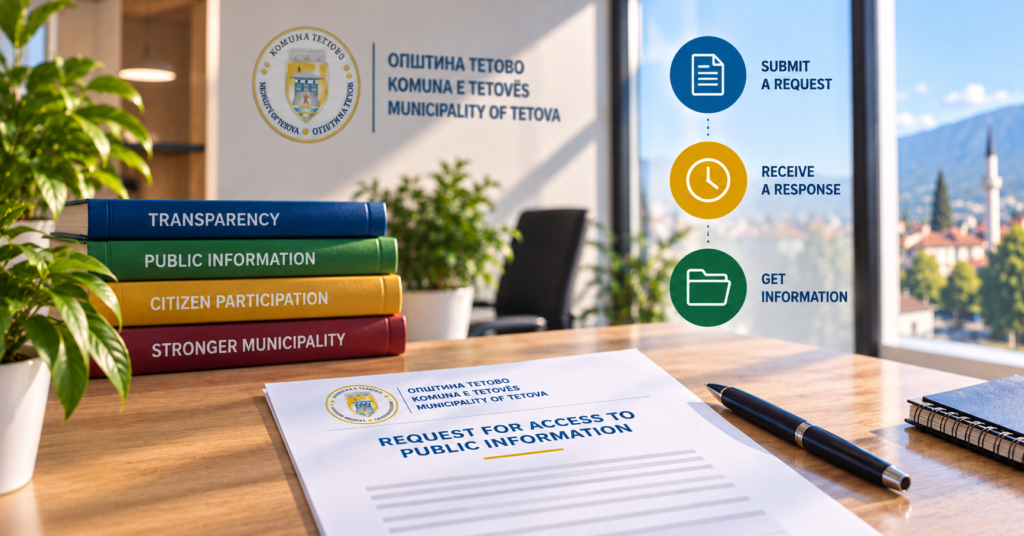
The law allows requests for access to information to be submitted in writing, electronically, or orally, in accordance with the legally prescribed procedure.
However, it is more practical for citizens to submit requests in writing or electronically, as this provides proof of when the request was submitted and exactly what was requested.
The Municipality of Tetovo has a dedicated section for Public Information, where citizens can find relevant documents and forms.
Request form: Municipality of Tetovo Public Information
Information regarding the responsible officials and the procedure for submitting requests is also published on the Municipality’s website.
What should the request contain?
The request should be sufficiently clear for the institution to accurately understand what information is being sought.
In practice, the citizen should provide their details, the institution being addressed, and the specific information requested.
It is also advisable to specify the desired format for receiving the information, for example, as an electronic document, a copy, or by inspecting the document itself.
How much time does the Municipality have to respond?
This is one of the most important elements of the procedure.
In accordance with Article 21 of the Law on Free Access to Public Information, the information holder is required to respond immediately, and no later than 20 days from the date the request is received.
In certain cases, this deadline may be extended to 30 days. This may occur, among other reasons, when partial access needs to be granted or when the requested information is voluminous.
If the deadline is extended, the institution must notify the requester electronically as soon as possible, but no later than seven days after receiving the request.
Therefore, the citizen should retain proof of the request’s submission, as the timeframes begin to run from that date.
What must the Municipality do after receiving the request?
The municipality, as the holder of the information, is obliged to act in accordance with the legally established procedure.
It must review the request, determine whether it possesses the requested information, and – provided the legal conditions are met – grant the citizen access to that information.
Public institutions are also required to designate authorized officials to facilitate access to information of a public nature.
The aim of the law is to ensure that institutions are open and transparent and enable natural and legal persons to exercise their right of access to information.
What if the Municipality does not possess the information?
If the institution to which the request was submitted does not hold the information, the procedure stipulates that the request be handled in coordination with the institution that does possess the information.
This is important for the citizen, as they should not be left without a response simply because the request was submitted to an institution that does not hold the information.
Can the Municipality reject the request?
Yes, but not arbitrarily.
The law provides for instances where access to information may be restricted—for example, to protect personal data, classified information, specific investigative proceedings, or other legally protected interests.
However, any restriction on access must have a legal basis.
When only a portion of a document contains protected information, partial access may be granted, making the remainder of the document available to the citizen.
What if the Municipality does not respond?
If 20 days pass without a response from the Municipality, or if the deadline has been legally extended and 30 days pass without a response, this constitutes “administrative silence.”
In such a case, the citizen has the right to legal recourse and may file an appeal with the Agency for the Protection of the Right to Free Access to Public Information.
The Agency processes appeals both when an institution fails to act within the statutory deadline and when a request has been rejected.
The appeal must be filed within 15 days of the expiration of the statutory deadline, or within 15 days of receiving the response or decision, depending on the specific case.
Appeal form: Agency – appeal form
Is there a charge for the information?
Access to public information is free of charge.
However, material costs may be charged for copying, photocopying, transcription, or electronic records, particularly when a large volume of information is requested.
This means that the citizen does not pay for the right of access itself, but in certain cases, there may be material costs associated with preparing the documents.
What should the citizen do in practice?
- Check whether the information has already been published.
- Specify the information you are seeking.
- Submit the request in writing or electronically and keep proof of submission.
- Wait for a response within 20 days, unless the deadline has been legally extended.
- If the Municipality extends the deadline, check whether you were notified within seven days.
- If you do not receive a response or the request is denied, consider filing an appeal with the Agency.
This procedure provides citizens with a concrete mechanism for requesting information, even when it is not readily available online.
Why is this right important?
Access to public information is not merely an administrative procedure.
It enables citizens to scrutinize how institutions function, how public funds are utilized, and how decisions affecting their lives are made.
For a young person in Tetovo, this can mean the right to ask how much a specific project cost, how much funding was spent on a particular activity, who was awarded a public contract, or what the Municipal Council decided.
Ultimately, the principle is simple: Citizens have the right to request information. Institutions have an obligation to act in accordance with the law.
Sources and patterns
- Municipality of Tetovo – Public information and request form
- Agency for the Protection of the Right to Free Access to Public Information
- Law on Free Access to Public Information
- Agency – appeal form
Author: Angel Stojanovski

This activity is supported by the CIVICUS Digital Democracy Initiative (DDI)