
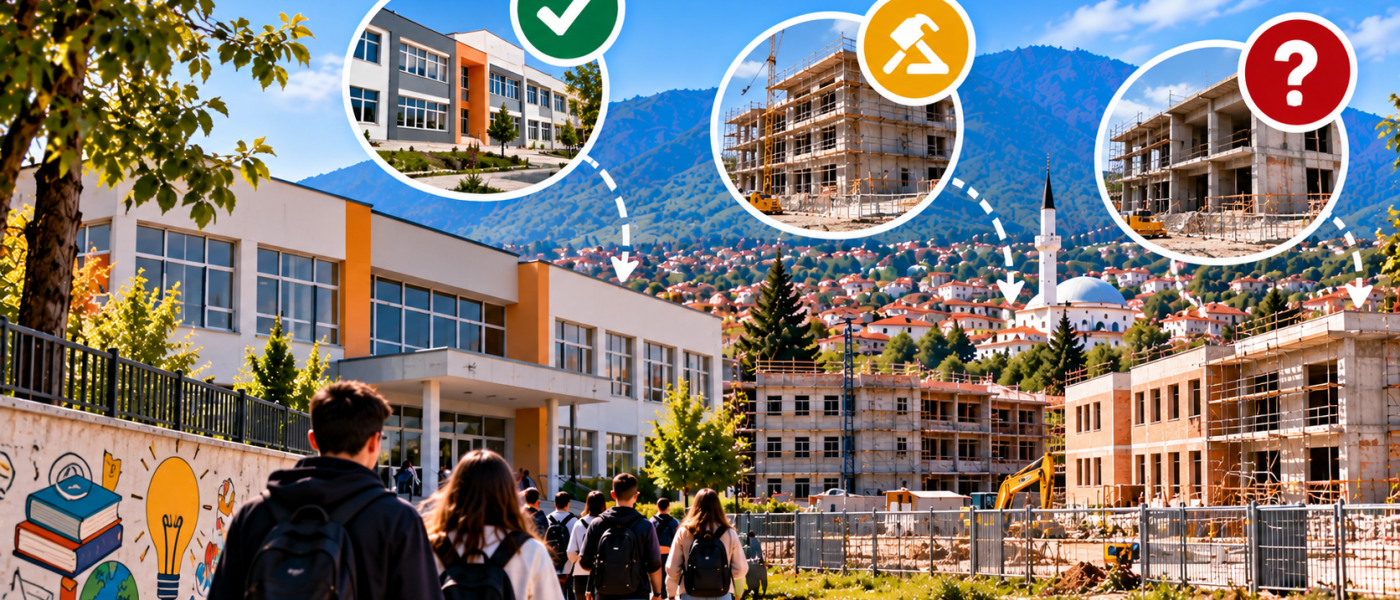

During 2026, educational infrastructure in Tetovo has been the focus of several investments and construction activities. Some projects have been completed, while others are still underway or delayed. Among the most significant are the reconstruction of the “Mosha Pijade” Regional Centre for Vocational Education and Training, the construction of new school buildings, the construction of the swimming pool at “Naim Frashëri” school, and improvements to conditions in existing schools. For students and parents, the key question is when these investments will be fully completed and ready for use.
According to announcements by the Municipality of Tetovo, statements by Mayor Bilall Kasami, and media reports published throughout the year, work has progressed in several areas. However, when assessing the results, it is important to distinguish projects that have been officially completed from those that are still being implemented.
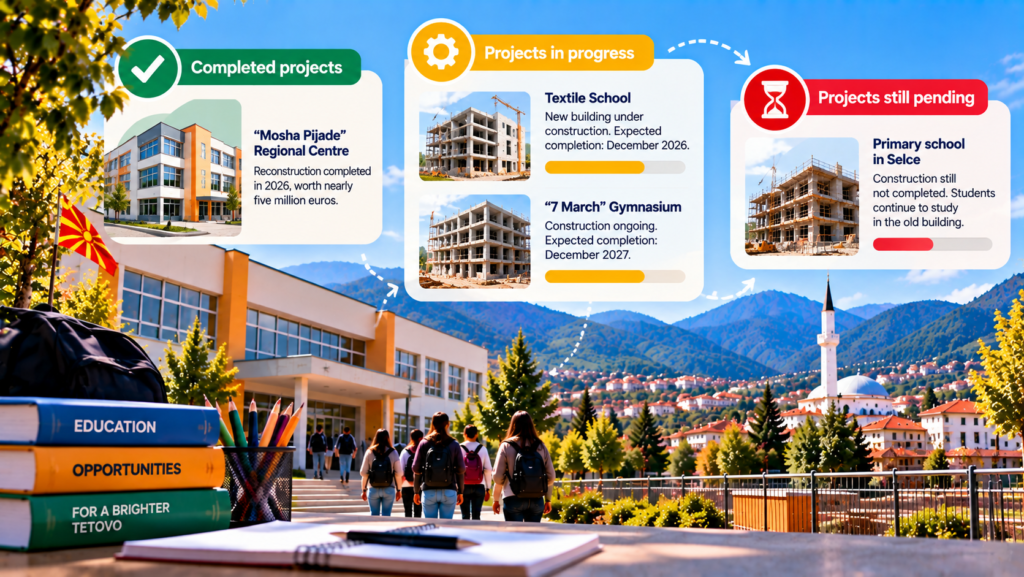
“Mosha Pijade”: Reconstruction worth nearly five million euros completed
One of the most significant educational projects completed in 2026 is the reconstruction of the “Mosha Pijade” Regional Centre for Vocational Education and Training in Tetovo. On 23 March 2026, the completion of the project was officially marked in the presence of Prime Minister Hristijan Mickoski, Minister of Education Vesna Janevska, European Union Ambassador Mihalis Rokas, and Mayor of the Municipality of Tetovo Bilall Kasami.
According to TS’s report on the completion of the centre’s reconstruction, the investment was worth nearly five million euros and included the reconstruction and equipping of all five buildings of the centre. The funds were provided from the state budget, with reimbursement from the European Union envisaged.
The works included an energy-efficient facade, new roofs, replacement of doors and windows, and improved accessibility for people with disabilities in the two main buildings.
The centre provides vocational education in several fields, including mechanical engineering, electrical engineering, hospitality and tourism, agriculture and veterinary medicine, as well as traffic and transport. According to information published at the opening, more than 1,000 students study there and around 150 teachers work at the centre.
This project can be considered an investment officially completed in 2026. Its benefits go beyond the renovated appearance of the buildings and include better conditions for vocational education and for preparing young people for the labour market.
The Textile School and “7 March” Gymnasium: Students are still waiting for the new buildings
Among the most important projects that have not yet been completed are the new buildings for the “Gjoce Stojcheski” Secondary Textile School and “7 March” Gymnasium. Their construction is part of a new school complex supported by the Government.
According to Alsat’s report of 31 August 2026 on delays in the construction of the Textile School and the school in Selce, work was continuing, but the buildings were still not ready for use. The Municipality stated that construction was progressing at an increased pace, while painting and furnishing were expected to take place at a later stage.
Students from the Textile School continue to attend classes at the “Besa” primary school in Small Rechica. Some attend classes in person, while others follow lessons online, according to Alsat.
In TS’s report of 14 August 2026 on the deadlines for the new Textile School and “7 March” Gymnasium buildings, the municipal education sector stated that the Textile School building was expected to be completed in December 2026, while the “7 March” Gymnasium building was planned for completion in December 2027. The authorities hoped that Textile School students would be able to begin the second semester in the new building, provided there were no further delays. Additional information on the delays was also published in Alsat’s report on the construction of the Textile School and “7 March”.
These are announced deadlines, not confirmation that the buildings will definitely be ready on the dates mentioned. Until the buildings are completed, equipped, and opened for use, the benefits of the investment remain limited.
The school in Selce: A project still awaiting completion
Another important investment is the construction of the new building for the “Rilindja” primary school in the village of Selce. The project is particularly important for residents of the village because students continue to study in the old school building, which needs better conditions.
According to Alsat’s report of 28 March 2026 on the condition of the school in Sellcë, construction had begun several years earlier, but even the first phase had not yet been completed. The municipal education sector expressed expectations that students would be able to use the new school during the 2026/2027 school year. However, the school principal raised concerns about the pace of the work and the tasks that remained to be completed.
According to media reports, around 230 students continue to study in an old building that is more than 70 years old. At the end of August, Alsat again reported that the school in Sellcë would not be completed during 2026. The remaining work included a retaining wall and other construction activities needed to complete the building.
According to statements by the Deputy Mayor cited by Alsat, the Government had allocated seven million denars for this phase of work in 2026. Additional funding and further public procurement procedures were needed to continue financing and implement the second phase. More information is available in the report on the unfinished school in Selce and the earlier report on construction delays.
This means that the project is ongoing and cannot be considered completed. For families in Selce, the main question remains when the new building will be ready and when students will be able to study in better conditions.
The swimming pool at “Naim Frashëri” school: Work continued in October
One project intended to improve sports facilities for students is the indoor swimming pool at “Naim Frashëri” primary school. During the summer, the Municipality of Tetovo announced that construction had entered its final phase and that the pool was expected to open soon.
According to KOHA’s report of 19 August 2026 on the swimming pool at “Naim Frashëri” school, Validin Ademi, the official responsible for the municipal education sector, stated that the facility would serve not only students and teachers, but also residents of the neighbourhood and other citizens.
However, on 6 October 2026, Mayor Bilall Kasami published footage of the construction work and announced that the building was continuing. This was also reported by Zhurnal in its article on the continued construction of the swimming pool. Therefore, as of early October, there was no clear confirmation that the pool had officially been put into operation.
During the summer holidays, other improvements were also made at the school: work was carried out in several classrooms, the parking area was improved, and new safety signage was installed. These works are important for a school with a large number of students, but they should be distinguished from the completion of the swimming pool as a separate facility.
“Bratstvo-Migjeni”: Improving conditions in the existing school
During the summer holidays, work was also carried out at “Bratstvo-Migjeni” primary school to improve the spaces used by students and teachers.
According to KOHA’s report on summer investments in Tetovo’s schools, works at “Bratstvo-Migjeni” school included painting the building, preparing new computer labs, and creating classrooms for all-day learning. In the section where lessons are taught in Macedonian, painting and facade works were still underway when the report was published.
These interventions can improve everyday conditions at the school. However, they should not be confused with the construction of a new building. A full assessment of the investment requires information about the value of the works, the source of funding, and the total amount spent by completion.
Municipal support for first-graders: €100 vouchers
In addition to investments in school buildings, the Municipality of Tetovo announced financial support for families whose children enrol in first grade in the 2026/2027 school year. According to the published information, vouchers worth €100 are planned for each eligible child.
The measure is intended to help parents cover some of the costs of school supplies and other basic needs at the beginning of the school year. More information is available in the report on €100 vouchers for first-graders.
How much funding is planned for investments in 2026?
The Municipality of Tetovo’s 2026 budget was adopted at the end of December 2025. According to Alsat’s report on the adoption of the municipal budget, the budget amounts to approximately 2.7 billion denars, or €44.5 million. Mayor Bilall Kasami stated that more than €17 million had been planned for capital investments in various areas.
However, this amount does not cover school investments alone. It also includes projects involving roads, water supply, sewage, public spaces, and other areas. Therefore, the total municipal budget does not show how much was actually spent on education during 2026.
To understand the cost of the investments, it is necessary to know how much was paid for each project, who provided the funding, and whether contracts or implementation deadlines were changed. These details are particularly important for projects that have continued for more than one year.
The Municipality of Tetovo publishes documents and announcements on its official website. To assess the results fully, citizens also need regularly updated financial implementation reports and information about each investment, so they can see not only how much money was planned, but also how much was spent and what was completed with those funds.
Investments should deliver concrete results for students
The picture of educational investment in Tetovo in 2026 is mixed. The reconstruction of the “Mosha Pijade” Regional Centre has been officially completed, while improvement works have been carried out at “Bratstvo-Migjeni” school. At the same time, the new buildings for the Textile School and “7 March” Gymnasium, the school in Selce, and the swimming pool at “Naim Frashëri” still await completion or confirmation that they have been opened for use. The announced first-grade vouchers represent an additional form of support for families.
For the Municipality of Tetovo and central institutions, the main challenge is to complete projects within the planned deadlines and provide clear information about costs and results. For students and parents, the question is more direct: when will they be able to study in new schools, use sports facilities, and benefit from improved conditions?
The success of public investment in education is not measured only by the funds planned or the works started. It is measured by whether schools are ready, whether students can use them, and whether transparency allows citizens to see how public money has been spent.
Author: Angel Stojanovski

This activity is supported by the CIVICUS Digital Democracy Initiative (DDI)