

The new Tetovo Municipal Council includes 11 women out of a total of 31 councilors. However, research shows that the presence of women on electoral lists and in decision-making bodies does not automatically translate into equal influence on policymaking.
When discussing women’s participation in local politics, the number of elected women is merely the starting point for analysis. A more critical question is whether women have genuine scope to participate in decision-making, propose policies, influence the budget, and help determine which citizens’ issues are prioritized.
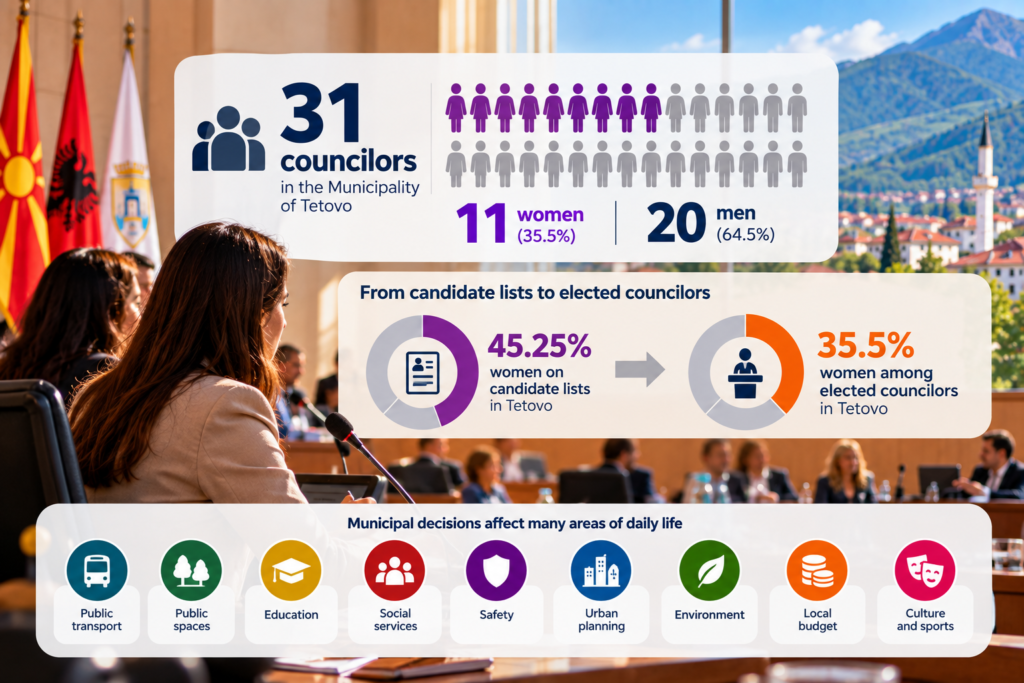
This is particularly important at the local level, as municipal decisions directly impact daily life, covering areas such as public spaces, public transport, street lighting, education, social services, safety, urban planning, sports, culture, and local budgets. According to UN Women (Women in Local Government), citizens participate in local decision-making through their elected representatives in precisely these areas: public services, urban and rural planning, environmental protection, local finance, culture, sports, social welfare, and education.
11 women in the new Tetovo Council
The Tetovo Municipality Council has a total of 31 members. The new Council, elected following the 2025 local elections, comprises 11 women and 20 men. This means that women make up approximately 35.5% of the Council. The new 31-member Council was confirmed after the 2025 local elections, and the list of its members has been published by the Municipality of Tetovo.
This means that today, approximately one in three councilors in the Municipality of Tetovo is a woman.
However, this figure becomes even more interesting when compared to the number of women who ran as candidates.
From 45.25% women on candidate lists to 35.5% women councilors
Research published in February 2026 by B-IRC (the Balkan Institute for Regional Cooperation) analyzes the representation of women, youth, and smaller ethnic communities in local-level decision-making processes within the Polog Region.
According to this study, women made up 45.25% of candidates on electoral lists in Tetovo, yet they account for 35.5% of elected councilors following the elections. Across the Polog Region as a whole, women comprise approximately 33% of elected councilors.
This is a noteworthy discrepancy: while women’s participation on electoral lists is relatively high, their representation in the elected body is lower.
The B-IRC study raises an even more significant issue: women’s involvement at the local level often remains more formal than substantive, while their actual influence on decision-making remains limited.
This implies that to truly understand women’s participation, it is not enough simply to count how many women appear on electoral lists or serve on the Council; we must also examine the role they play in the decision-making process.
Representation is not the same as decision-making power
A B-IRC analysis on gender equality and local decision-making indicates that quotas can contribute to increasing women’s formal presence in politics, but that numerical representation alone does not guarantee their substantive participation in decision-making.
This issue is not unique to Tetovo. Research on women’s political and public participation in North Macedonia reveals various barriers to their full engagement in public life, particularly for women belonging to smaller ethnic communities.
Therefore, when discussing Tetovo, the question should not merely be “How many women serve as councilors?” but also “How much opportunity do they have to influence the decisions being made?”
The municipality has mechanisms for gender equality
Women’s participation in local decision-making is not limited to elections alone; the institutional framework also provides for specific gender equality mechanisms.
The Municipality of Tetovo has a Commission for Equal Opportunities between Women and Men, established by a decision of the Municipal Council in 2013. This decision was published in the “Official Gazette of the Municipality of Tetovo” (No. 2/2013, page 18).
At the national level, gender equality is also supported by the legal framework for equal opportunities. The Ministry of Social Policy, Demography and Youth publishes the relevant laws and acts in this area.
In practice, these mechanisms are important because they can serve as channels for incorporating women’s perspectives into local policies and the work of the Council.
However, the mere existence of a commission is not enough to determine its impact.
What citizens need to see is: what proposals the commission has submitted, which issues it has addressed, what recommendations it has made, and the extent to which these have been reflected in the municipality’s decisions.
Women should not be just a statistic
One of the issues regarding political participation is that representation can easily be measured in numbers, whereas influence is much harder to quantify.
We can know how many women serve on the Council. We can know how many women ran as candidates. We can know how many women are members of the committees.
However, for a more comprehensive analysis, we also need to know:
How many proposals did female councilors submit? How many of them were adopted? Which committees do they participate in? How many women hold leadership positions within the Council’s working bodies? Are issues affecting women included in budget discussions? And are local policies formulated with women’s needs in mind?
These questions shift the discussion from “How many women are there?” to “How much influence do they have?”
The Council’s committees also show something
The composition of the committees is particularly important, as part of the preparatory work for the Council’s decisions takes place precisely within these working bodies.
In a decision published in the “Official Gazette of the Municipality of Tetovo” (No. 21/2025), for instance, the Council’s Finance and Budget Committee was established with a woman serving as chairperson and another as a member, alongside the other members. The decision stipulates that this committee reviews matters related to municipal finances, the adoption of the budget, the final account, and other financial acts.
This is an area of particular significance: the budget is one of the primary instruments through which policies are translated into concrete actions.
Therefore, women’s participation in budget-related processes is just as important as their presence in the Council.
Gender equality should also be viewed through the lens of the budget
In October 2025, UNDP in North Macedonia released a handbook on gender equality at the local level, designed for municipal councilors and focused specifically on local policy-making and budgeting processes. Developed in collaboration with UN Women, the handbook aims to assist councilors in integrating gender equality principles into local policy-making and budgeting.
This is significant because a policy may exist on paper, yet without financial resources and concrete implementation, its impact can be limited.
Therefore, to assess the extent to which the Municipality of Tetovo includes women in local policies, it is not enough to look solely at gender equality programs; we must also examine the planned and actual expenditure, as well as the results achieved.
Another issue: Are women’s needs visible in local policies?
A study by Reactor on gender-based violence against women and girls in public spaces in Skopje and Tetovo, published in 2025, also examined the transparency of local documents related to gender equality and women’s safety.
Regarding Tetovo, the study found that during the monitoring period, no strategy, action plan, or operational plan for gender equality was publicly available on the Municipality’s website. The report notes that this hinders transparency and accountability in this area. This finding stems from monitoring conducted in 2025 and should not automatically be interpreted as reflecting the situation in 2026.
This distinction is important. Institutions can adopt new documents, programs, or mechanisms. Therefore, the situation requires continuous monitoring rather than assessment based on a single point in time.
What does this mean for a woman from Tetovo?
If a woman faces a lack of street lighting in her neighborhood, unsafe public spaces, a lack of care services, transportation issues, or difficulties accessing sports or public areas, these are not necessarily just “women’s issues.”
They are matters of local policy.
However, the way a municipality identifies these problems, prioritizes them, and allocates funds to address them can differ if the diverse perspectives of citizens are included in the decision-making process.
Therefore, women’s participation in the Council and its committees should not be viewed merely as a matter of political representation; it is also linked to how public policies are shaped.
11 out of 31 is a start, but it is not the complete answer
Today, 11 out of the 31 councilors in the Municipality of Tetovo are women, approximately 35.5%. In the 2025 local elections, women made up 45.25% of the candidates for the Tetovo council. Both figures are significant, yet they do not tell the whole story.
Recent research in the region indicates that the challenge lies not merely in increasing the number of women in local institutions, but in ensuring that representation translates into genuine participation in the decision-making process.
For the citizens of Tetovo, therefore, the question becomes more specific:
Does the presence of 11 women on the Council actually shape the Municipality’s decisions, policies, and budgets?
This can only be gauged by monitoring meeting minutes, the work of committees, proposals, programs, budgets, and their implementation.
After all, gender equality in local politics is measured not just by how many women sit at the table, but by the extent of their influence on the decisions made there.
Author: Angel Stojanovski

This activity is supported by the CIVICUS Digital Democracy Initiative (DDI)