


The transparency of local government is not measured only by the number of documents published on a municipality’s official website. It is measured by whether citizens can understand decisions, know how public money is spent, receive timely answers, and influence issues that shape their everyday lives. For the Municipality of Tetovo, as for every other municipality in North Macedonia, the challenge is to ensure that transparency does not remain a formal obligation, but becomes a consistent practice of informing, consulting and being accountable to citizens.
At the local level, decisions on the budget, public transport, road maintenance, urban planning, education, social protection and municipal services directly affect people’s lives. Information about how these decisions are made, which priorities receive funding and what results are achieved should therefore be understandable not only to the administration or financial experts, but to every citizen who wants to know how their municipality works.
How transparent is the Municipality of Tetovo compared with other municipalities?
To assess the Municipality of Tetovo’s transparency, it is important to use independent and comparable indicators. One assessment published in 2026 is the Local Self-Government Transparency Index for 2025, prepared by Transparency International-Macedonia.
This pilot assessment covered eight municipalities, selecting the most populous municipality in each planning region. Tetovo was one of them. The assessment was based on a questionnaire with 91 questions and analysed websites, documents, responses to requests for free access to information, the functioning of the administration, and citizens’ access to services. The methodology and municipality selection are explained in the full report by Transparency International-Macedonia, pages 4-6 of the PDF.
According to the results published in the Local Transparency Index for 2025, page 7 of the report, the eight municipalities were ranked as follows:
- Bitola – 67 points
- Veles – 60 points
- Shtip – 55 points
- Strumica – 54 points
- Kumanovo – 51 points
- Aerodrom – 49 points
- Tetovo – 43 points
- Ohrid – 39 points
The average score for the eight municipalities was 52 points. With 43 points, Tetovo was below the group average and ranked second to last, ahead of Ohrid. The results indicate considerable room to improve transparency and accountability, particularly by publishing complete information and making it easier for citizens to use it.
It is important to note that this was a pilot assessment of eight municipalities, not a ranking of every municipality in the country. Tetovo’s result should therefore be understood as a comparison with the other seven municipalities included in the study, not as a nationwide ranking.
Another indicator is the Active Transparency Index for 2025, which measures the proactive publication of specific categories of information by institutions. According to results published by Open Data on 16 September 2025, Tetovo scored 81.4 percent and ranked 59th overall among the institutions assessed. In 2024, its score was 80.6 per cent, according to the Active Transparency Index for 2024.
At first glance, this result appears more positive than the local transparency index. However, the two assessments do not measure the same things. The Active Transparency Index focuses on proactive publication of information, while Transparency International’s assessment also examines access to services, responses to requests, council activity, and public participation.
The results should therefore not be compared directly as if they were the same measurement. They show that transparency has several dimensions and that a relatively good score for publishing information does not remove the need for improvements in other areas.
Publishing documents does not automatically mean that citizens can easily understand decisions, receive answers, or influence local policies. Transparency should be assessed both by what the municipality publishes and by how information can be used to enable meaningful accountability.
Access to public information: a legal right and an institutional responsibility
Every citizen has the right to request information about the work of public institutions. This right is established by the Law on Free Access to Public Information and applies to municipalities as well.
The Municipality of Tetovo’s official website has a dedicated section for public information. It provides information about the officials responsible for facilitating access to information, how to submit requests, a request form, a complaint form, and the procedures for processing requests.
This is an important starting point for citizens who want to request documents or data that they cannot find on the official website. However, forms and procedures alone are not enough. A functioning system should make it easy for citizens to understand where to direct a request, what information they can request, and what to do if they receive no answer.
According to the Agency for the Protection of the Right to Free Access to Public Information, the usual legal deadline for a response is 20 days. Where more time is required, the deadline may be extended to 30 days under the conditions set by law, and the requester must be notified of the extension within the relevant timeframe.
These deadlines should not be treated as a target waiting time for every response. When information is already available and can be provided immediately, institutions should aim to supply it without unnecessary delay.
How quickly does the Municipality of Tetovo respond in practice? The Local Transparency Index for 2025 provides a useful data point. As part of Transparency International-Macedonia’s testing, requests for public information were sent to the municipalities included in the assessment. According to the report, page 11 of the PDF, all municipalities except Ohrid responded on time. This means Tetovo responded within the expected timeframe in that particular test.
However, this result does not show how many days the municipality takes on average to respond to all requests. Such an assessment would require detailed statistics on all requests received and processed during the year.
Further data are provided by the Active Transparency Index for 2025. According to results published by Open Data, the municipalities covered by the assessment took an average of 21 days to respond to public-information requests, compared with 15 days in the previous year. Only 54 per cent of the institutions assessed responded within the legal deadline of 20 days.
This figure refers to the assessed institutions as a whole and should not be interpreted as the average response time of the Municipality of Tetovo. It nevertheless indicates that response times remain an institutional challenge and that transparency requires not only publishing documents, but also processing citizens’ requests promptly.
For Tetovo’s transparency, the question is not only whether the municipality has a designated official or follows formal procedures. It is also important to know how many requests are received each year, how many receive a response within the deadline, how many are refused, how many complaints are filed, and how long it takes on average to obtain information.
Publishing these statistics would be an important step towards accountability. The municipality could publish a simple annual report showing the number of requests, average response time, the share handled within the deadline, and the most common reasons for refusal or delay.
Proactive publication: citizens should not have to request every document individually
Access to public information should not operate only through individual requests. A transparent municipality should publish as much information of public interest as possible in advance, without waiting for citizens, journalists or civil society organisations to ask for it.
This includes the adopted budget and amendments, budget execution reports, public procurement contracts, council decisions, meeting minutes, annual programmes, work reports, subsidies, grants, agreements with economic operators and reports on project implementation.
The municipality should also publish information about its services: required application documents, deadlines, fees, contacts, opening hours, eligibility conditions and complaint procedures. This is particularly important for citizens who lack legal knowledge or experience dealing with public administration.
The municipality’s former official website, for example, contains budget documents and Tetovo’s citizens’ budget. A citizens’ budget is especially important because it aims to present municipal finances in a simpler format and help citizens understand how public funds are planned and used.
Documents should, however, be up to date, organised by year and topic, easy to find and available in formats that can be opened and used. An important document placed in an old archive, published only as an illegible scan or stored under an unclear category may technically be online but remain practically inaccessible to many citizens.
The budget section of Transparency International-Macedonia’s report, on page 9 of the PDF, notes that municipal budgets are published, but not always in readable and searchable formats. In some cases, they are scanned documents, making it harder to search, copy, and analyse the data.
Transparency therefore does not end with publishing a PDF. It requires a clear system through which citizens can quickly find information about a project, contract, decision or service without navigating numerous pages and technical documents.
The municipal budget: citizens have the right to know where their money goes
The municipal budget is one of the most important areas of transparency. It is not merely a financial document for the administration; it reflects the municipality’s priorities and shows which public needs are funded, how much is allocated to each area, and what is expected to be achieved.
When the municipality allocates money for public transport, education, roads, lighting, sanitation, social protection or sport, citizens should be able to understand not only the planned amount, but also why it was allocated and what results are expected.
For example, if a municipal programme allocates a specific amount for road maintenance, the public should be able to see which roads are scheduled for work, which works have been contracted, how much they cost and whether they have been completed. If funds are allocated to public transport, citizens should be able to see how many buses are available, the cost of the service, which routes are covered, and whether new investments are planned.
The same logic applies to social assistance. An amount included in the budget does not automatically mean that it has been spent or that the intended citizens have received the assistance. The approved amounts, actual expenditure, beneficiaries by category, and programme results should therefore be published, while respecting privacy and personal-data protection.
The difference between the planned and executed budget is essential. If the municipality plans to invest a certain amount in a project but spends only part of it, the public should know why, whether the project was delayed, whether the contract changed, and how this affected citizens.
To improve budget transparency, the Municipality of Tetovo could publish periodic reports with simple tables showing:
- Funds approved for each area.
- Funds spent up to a specified date.
- Funds remaining unspent.
- Projects completed, under way, or delayed.
- Project costs and concrete results for citizens.
- Changes made during the year and the reasons for them.
These data should be published in formats citizens can understand, not only in accounting tables or documents requiring specialised financial knowledge. A simple table, chart or plain-language explanation can make the budget much easier to understand.
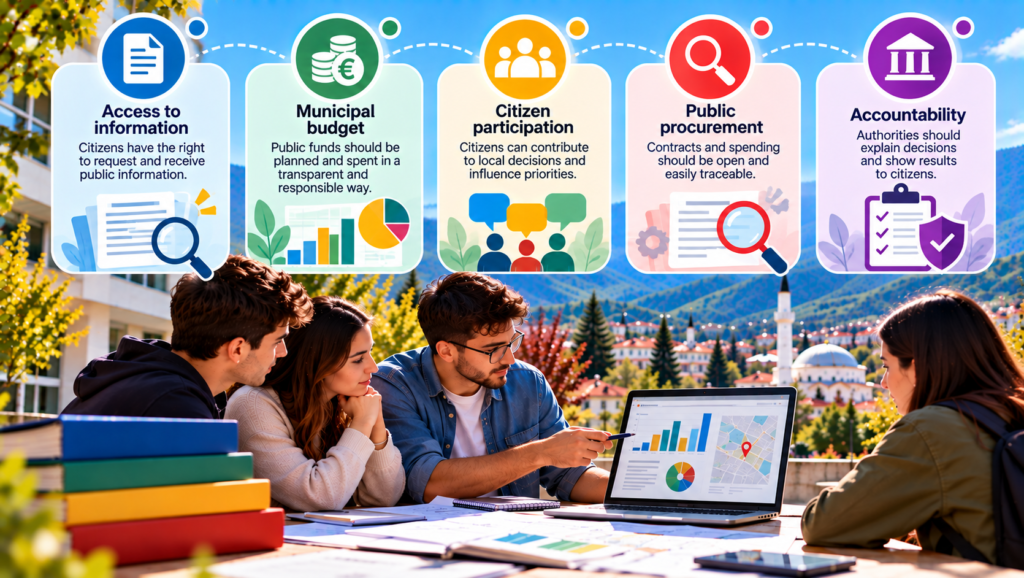
The Municipal Council: a body that should demand accountability
Debates about local transparency often focus on the mayor and the administration. However, the Municipal Council of Tetovo has an equally important role: councillors are elected representatives of citizens and are responsible for decisions that affect local life.
Under the Law on Local Self-Government, Articles 39-41, pages 10-11 of the PDF, council meetings are convened as needed and at least once every three months. Notice of the date, time, place, and proposed agenda of an ordinary meeting must be published at least seven days in advance. The law also regulates how meetings are held and how the council operates.
These are not merely procedural provisions. They create opportunities for the Council to act as an important mechanism for oversight and accountability.
Councillors should not limit their role to attending meetings and voting on proposals. They should seek explanations for decisions, ask about project implementation, request expenditure reports, and raise concerns brought forward by citizens. When a project is delayed, a service does not work, or a budget line is not implemented, the Council should demand clear answers.
To make this role more effective, councillors’ questions, the mayor’s responses, submitted proposals and voting results should be published systematically. Citizens should be able to see not only what was decided, but also who proposed it, who supported it, who voted against it, and what arguments were presented.
Transparency International-Macedonia’s report treats council activity as one of its eight main assessment areas. According to the findings on municipal councils, page 8 of the report, municipalities generally publish adopted decisions, but in some cases do not publish proposals and supporting documents in advance. Publishing each councillor’s individual vote is also not common practice.
This shows that council transparency should cover not only the final decision, but also the process leading to it. When citizens can access preparatory materials and follow the discussion, they are better able to understand their representatives’ reasoning.
A municipal council that consistently asks for explanations and follows up on implementation strengthens democratic oversight. Conversely, if decisions are adopted without sufficient debate or follow-up, transparency remains limited even when documents are published.
Citizens should participate in decision-making, not merely observe it
Transparency has limited value if citizens are informed only after decisions have been made. A democratic municipality should allow residents to help set priorities, submit proposals and express their views before decisions affecting their lives are adopted.
This can be done through public hearings, budget consultations, neighbourhood meetings, debates on urban plans, surveys and digital platforms for citizens’ proposals.
Consultation must not be merely formal. If the municipality organises a public hearing, it should publish materials in advance, explain how citizens can participate and record the proposals received. After the consultation, it should indicate which proposals were accepted, which were not and why.
This is particularly important for groups that often have fewer opportunities to be heard: young people, persons with disabilities, low-income families, older people, ethnic communities and residents of areas less involved in decision-making.
Citizen participation does not mean every proposal must be accepted. It means every proposal should be considered seriously and citizens should be able to understand the reasons behind the final decision.
When citizens see their views being considered, trust in institutions grows. When consultations are held only to fulfil a procedure, without visible influence on decisions, people may conclude that public participation makes no difference.
Municipal services should be as accessible as possible
Transparency and access to services are closely linked. A municipality may publish a great deal of information, but if citizens must navigate complicated procedures, visit the administration several times or seek help to understand documents, the service is not fully accessible.
Information about municipal services should be clear and practical. Citizens should know where to go, which documents are required, how long a procedure takes, whether a fee applies and whom to contact if a problem arises.
The municipality should therefore develop services that are simple, accessible and adapted to citizens’ needs. This includes information desks, working contact details, understandable forms, electronic services where possible and support for people with limited digital skills.
Online services can make communication with the administration easier, but should not be the only way to access services. Not all citizens have the same devices, internet access, or technological knowledge. Digital services should therefore be complemented by in-person options and assistance for those who need it.
Language also matters. In a multilingual municipality such as Tetovo, information of public interest should be available in the relevant languages, using understandable terminology and avoiding unnecessary technical wording. Information that citizens cannot understand does not fully serve the purpose of transparency.
A good public service is measured not only by whether it exists, but also by the time citizens need to use it, the costs they must bear, the clarity of the procedure, and how the institution treats them.
Transparency International-Macedonia’s report, page 10 of the PDF, notes that some municipalities lack functioning service centres or have centres that are not organised to help citizens obtain information. The issue is not simply whether a service desk exists, but whether it can provide clear guidance and help people exercise their rights.
The role of the media: turning documents into understandable information
The media play an important role in overseeing local government and informing citizens. They can analyse budgets, compare promises with results, monitor project implementation and seek explanations for decisions that affect everyday life.
Their role should not be limited to repeating municipal announcements or officials’ statements. An announcement that a project has been approved does not necessarily explain how much it costs, when it should be completed, who will benefit, or how success will be measured.
Instead of reporting only that the municipality has allocated money for an investment, journalists can analyse budget documents, locate the relevant contract, compare the planned amount with the contracted amount and check whether the work was completed on time.
For public transport, the media can examine the number of buses, operating costs, ticket revenue, municipal subsidies, timetables and the need for new routes. For infrastructure projects, they can analyse contract values, price changes, delays and effects on residents.
This type of reporting requires time and the ability to analyse public documents, but it is essential for making budgets and institutional work understandable to the public.
The media should also follow up on citizens’ questions and give visibility to problems that institutions fail to answer. When an issue recurs across several neighbourhoods or affects many residents, reporting can help bring it to institutional attention.
This role requires editorial independence, fact-checking, and giving the relevant institution an opportunity to respond. The aim is not to blame the municipality automatically, but to ensure that public decisions and spending are examined impartially.
The role of civil society: monitoring, explaining and representing the public interest
Civil society organisations can serve as a bridge between citizens and institutions. They can analyse documents, monitor expenditure, request information, organise public debates and help citizens understand their rights.
In many cases, citizens do not have enough time or knowledge to examine lengthy budget documents, financial reports or public procurement procedures. Civil society organisations can turn this information into simpler analyses, comparison tables and reports showing what was planned, what was delivered and which issues require clarification.
They can also monitor how citizens are included in decision-making. For example, they can assess whether public hearings are held on time, whether documents are published before meetings, whether citizens’ proposals receive responses and whether marginalised groups have a genuine opportunity to participate.
To be effective, civil society organisations should rely on verifiable data and preserve their independence. Their role should not be limited to criticism; they should also propose concrete ways to improve transparency, services and public participation.
Cooperation between the media and civil society can be especially useful. Organisations can conduct research and analysis, while the media present the findings in an accessible way to a wider audience. In this way, information does not remain confined to technical reports but becomes part of public debate and a potential driver of change.
Public spending efficiency: knowing how much was spent is not enough
Transparency is directly connected to the efficiency of public spending. Citizens should know not only how much money was spent, but also what was achieved with it.
If a project is expensive, the question is not only whether payment followed the required procedures. It is also necessary to examine whether the project achieved its objectives, whether the quality is appropriate and whether the investment responds to citizens’ real needs.
For example, if money is invested in public lighting, citizens should know how many streets were lit, how many lighting points were installed, and whether the service works. If youth programmes are funded, activities, participant numbers and results should be published. If subsidies are awarded to organisations or specific groups of citizens, selection criteria and beneficiaries should be transparent, in line with personal-data protection rules.
Financial reports should therefore be accompanied by reports on results. Expenditure may be lawful without necessarily being efficient or serving the best public interest.
A sound accountability system connects three elements: planning, spending and results. Citizens should be able to follow the chain from the decision to allocate funds to the concrete benefit delivered to the community.
What can the Municipality of Tetovo do to improve transparency?
Published data and independent assessments show that transparency should be treated as an ongoing process. Improvement requires not only more documents, but better organisation of information, faster responses and more direct communication with citizens.
Several practical steps could help:
- A clear transparency portal. Organise key documents by topic and year, with simple search and working links.
- Periodic publication of budget execution. Alongside the adopted budget, publish expenditure reports and project progress at regular intervals.
- Statistics on public-information requests. Publish the number of requests, average response time, the share answered within the legal deadline, and the number of complaints.
- Greater council transparency. Publish agendas and supporting materials in advance, followed by minutes, voting records and responses to councillors’ questions.
- Public consultations with real impact. Involve citizens before decisions are made and explain how their proposals were considered.
- Simple information in multiple languages. Accompany technical documents with understandable summaries, tables and public-facing explanations.
- Monitoring results, not just activities. Reports should show not only what was done, but also what it cost and what difference it made to citizens.
- Easier access to services. Simplify procedures, keep contact details updated, and provide help to citizens who cannot use electronic services.
These measures would create a system in which transparency does not depend only on a journalist’s interest or an individual citizen’s request, but becomes a normal part of the administration’s work.
Transparency as a condition for trust and local democracy
The municipality is the level of government citizens experience most directly. Its decisions affect the streets they walk on, the transport they use, the schools their children attend, the public spaces where they spend time, and the services they need every day. Local transparency is therefore not merely an administrative issue; it is a fundamental condition for democracy and public trust.
Transparency International-Macedonia’s 2025 assessment, in which Tetovo scored 43 points among the eight municipalities examined, shows that there is room for improvement. Meanwhile, the score of 81.4 per cent in the Active Transparency Index indicates that proactive publication of documents is a separate dimension that should be assessed independently. Together, the indicators underline that transparency should not be viewed only as document publication, but also as practical access to information and services, participation in decision-making and accountability.
Improving this situation requires commitment from all sides. The municipality should publish complete and understandable information; the Council should demand accountability and oversee the implementation of decisions; the media should analyse documents and scrutinise promises; and civil society should monitor, propose solutions and help citizens understand their rights.
Ultimately, transparency should not be measured only by asking how many documents have been published, but by asking how easily citizens can understand what is happening in their municipality. Can they find the budget? Can they understand where the money is spent? Can they receive an answer on time? Can they influence a decision that directly affects them? And can they demand accountability when results do not match promises?
A transparent municipality is not simply one that publishes information, but one that makes information understandable, accepts public scrutiny and gives citizens real opportunities to participate in decision-making. When the budget is accessible, decisions are explained, expenditure is scrutinised, and citizens’ voices are heard, transparency becomes more than a legal obligation: it becomes a practice that strengthens local democracy and brings government closer to the people it serves.
Author: Angel Stojanovski

This activity is supported by the CIVICUS Digital Democracy Initiative (DDI)