

The Municipality of Tetovo has allocated over 31 million denars for protection, rescue, and crisis management in 2026. But where does this money go? How much is earmarked for equipment, training, and field response, and how much for shelters?
When a flood, fire, earthquake, or landslide occurs, the citizen’s question is usually simple: Are we prepared?
The answer depends not only on the number of firefighters or how quickly help arrives. It also depends on equipment, shelters, trained personnel, communication, and, above all, the funds planned in advance for crisis prevention and management.
In the case of Tetovo, public documents show that there is a dedicated program for protection, rescue, and crisis management for 2026.
31 million denars for protection and rescue
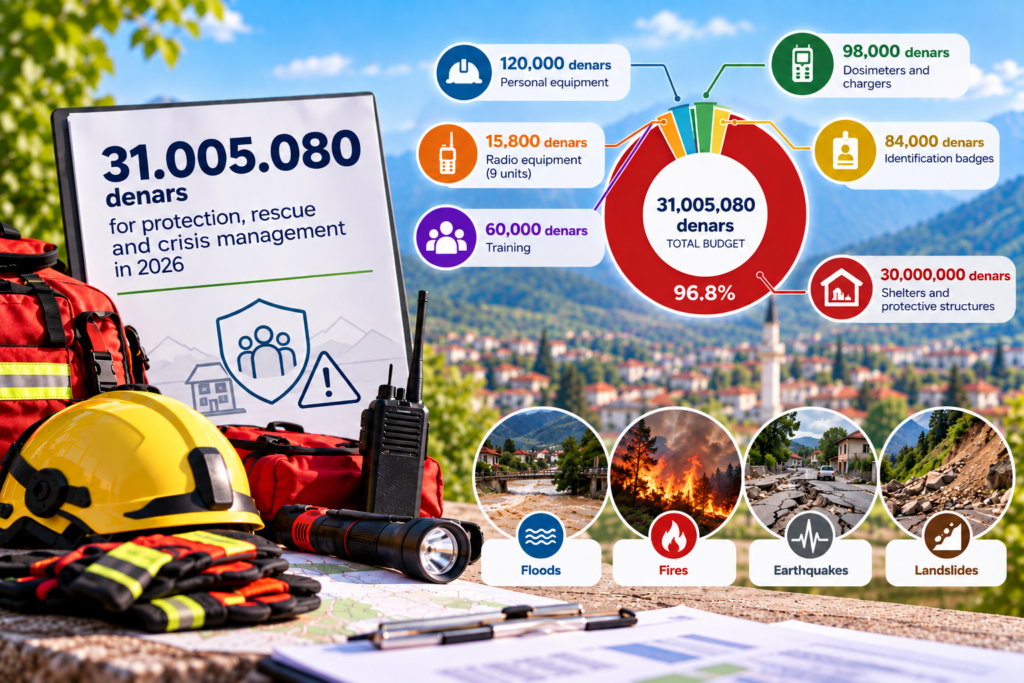
According to the Municipality of Tetovo’s official Program for Protection, Rescue, and Crisis Management for 2026 (pages 76–78 of the document), a budget of 31,005,080 denars is planned for the implementation of these activities.
These funds are allocated under program Q0, account code 426990, and are financed by the Municipality of Tetovo’s budget.
When comparing this amount to the Municipality’s total budget for 2026, which stands at approximately 44.7 million euros, the fund for protection, rescue, and crisis management represents a relatively small portion of the overall budget.
However, the total figure does not tell the whole story.
What is more interesting is how the 31 million denars are distributed.
Almost 97% go to shelters
Of the planned 31,005,080 denars, 30 million denars are allocated for the maintenance of and investment in shelters and other protective structures within the Municipality’s territory.
This represents approximately 96.8% of the program’s total budget.
In other words, for every 100 denars planned for this program, about 97 denars are earmarked for shelters and protective structures, while around 3 denars remain for equipment, training, and other measures outlined in the program.
This is one of the most interesting details emerging from the official document.
The program does not merely state a total figure; it also outlines the need to inspect and maintain the shelters, including checks on their condition, ventilation, utility systems, equipment, and hygiene. The Municipality of Tetovo’s protection and rescue program (pages 76-78) stipulates that these shelter inspections are to be carried out by the relevant municipal services.
Thus, on paper, the vast majority of the funds is directed toward protective infrastructure.
And what about the equipment for the people who need to respond?
This is where the situation becomes more interesting.
The program provides for a range of equipment for members of the protection and rescue forces.
A sum of 120,000 denars is allocated for personal equipment. 23,000 denars are planned for seven command dosimeters, while 75,000 denars are earmarked for two dosimeter chargers.
Also planned are nine radio units costing 15,800 denars, identification badges for 42 personnel costing 84,000 denars, protective masks for 42 personnel costing 17,600 denars, and other personal equipment—including individual first-aid dressings, protective coverings, and decontamination gear.
The document also lists shared unit equipment, first-aid supplies, and tools for repairing electrical installations.
In total, these equipment costs are relatively modest compared to the 30 million denars allocated for shelters.
There are also funds for training
The program is not solely about equipment.
The municipality has allocated 60,000 denars for the training of protection and rescue forces.
The program also outlines that, to ensure the system functions effectively, activities such as force education and training, training for local government officials, drills, and public awareness campaigns will be carried out.
This is important because an emergency response system relies on more than just the equipment stored in warehouses; in a crisis, that equipment must be used by people who know exactly what needs to be done.
And one more small but interesting investment: lightning protection
The program allocates 250,000 denars for the reconstruction of the lightning protection system, specifically, the lightning rod installation, at the municipal building.
This is a preventive measure, demonstrating that the program focuses not only on responding after an incident occurs but also incorporates specific risk-reduction measures.
This aligns with the Protection and Rescue Directorate’s description of the protection and rescue system, which encompasses both preventive and operational measures addressing earthquakes, floods, fires, landslides, and other emergencies.
Are these risks merely theoretical?
No.
In 2026, Tetovo and the Polog region faced several events demonstrating why emergency preparedness is a concrete issue.
In February 2026, heavy rainfall caused landslides, rockfalls, and the flooding of basements and local roads in the Tetovo region. According to the Crisis Management Center, as reported by SDK a landslide on the road to Kodra e Deljit posed a threat to nearby residential buildings as well.
During the same period, teams from the Directorate for Protection and Rescue intervened in several municipalities, including Tetovo, due to flooding and rivers overflowing their banks.
Earthquakes also pose a real risk. On February 10, 2026, an earthquake with a local magnitude of 4.6 and an epicenter in Kosovo was felt in Tetovo, Gostivar, and Skopje, according to the Seismological Observatory at the Faculty of Natural Sciences and Mathematics in Skopje and reports by MIA.
Therefore, when the Municipality allocates funds for protection and rescue, it is not dealing with a hypothetical scenario.
Tetovo now also has territorial protection and rescue forces
In February 2026, the Tetovo Municipality Council adopted a decision to establish territorial protection and rescue forces, and a municipal protection and rescue headquarters was also formed.
According to a report by Portalb, these structures are linked to responding to risks such as landslides, earthquakes, and floods.
The Municipality of Tetovo itself describes the Protection and Rescue Sector as a structure that monitors the potential for crises, proposes budget allocations, and prepares rescue and disaster response programs.
This implies the existence of an institutional structure tasked with managing this part of the system.
But there is one major question: how much has actually been realized?
This is where public documents become less clear.
The program outlines the plans for 2026 and the funds allocated for each activity.
However, the program document alone does not reveal how much of the 31,005,080 denars has actually been spent to date, what equipment has been procured, which shelters have been renovated, or how many training sessions have been conducted.
This represents a crucial distinction in public finance:
The budget shows the plan.
The financial report shows the actual implementation.
In upcoming articles, we will provide further details on how much of these funds has been utilized so far this year, what expenditures have been incurred, exactly what the funds were spent on, and what can be verified through public documents.
By doing so, we will distinguish between what was planned in the budget and what was actually implemented, allowing citizens to see more clearly where funds designated for protection and rescue are going.
For the citizen, both are essential.
The program itself stipulates that implementation is to be monitored by the Municipality in cooperation with the Municipal Protection and Rescue Headquarters, the Directorate for Protection and Rescue, the Crisis Management Center, and the bodies of the Municipal Council.
What would be interesting for the public to know?
For a robust transparency system, citizens should be able to see not only the figure of 31 million denars but also what was done with those funds.
For example: which shelters have been inspected and maintained? How much of the 30 million denars has been spent? What equipment has been procured? How many of the 42 personnel have been equipped with the planned gear? How many training sessions and exercises have been conducted? Has the lightning protection system been renovated? And how much of the funding remains unspent?
These questions go beyond mere financial transparency.
They concern the safety of the citizens.
A budget that only comes into view when a disaster strikes
The budget for protection and rescue differs from many other public expenditures.
If a road is built, citizens can see it.
If a park is developed, citizens use it.
However, when funds for protection and rescue are well spent, the most important outcome may be something that doesn’t happen: a building left undamaged, a person rescued more quickly, a landslide prevented, or a fully equipped team arriving exactly where needed.
Therefore, the 31 million denars allocated for 2026 should not be viewed merely as a budget figure.
They represent a planned investment in how Tetovo will respond when a genuine risk escalates into an emergency.
And the question facing the public is very specific:
If a flood, fire, earthquake, or landslide were to occur tomorrow, how many of the preparations funded by the budget would actually prove effective?
That is precisely what the implementation report needs to demonstrate.
Author: Angel Stojanovski

This activity is supported by the CIVICUS Digital Democracy Initiative (DDI)