


From capital investments to public transport, education, and public services, what does the comparison between 2025 and 2026 show?
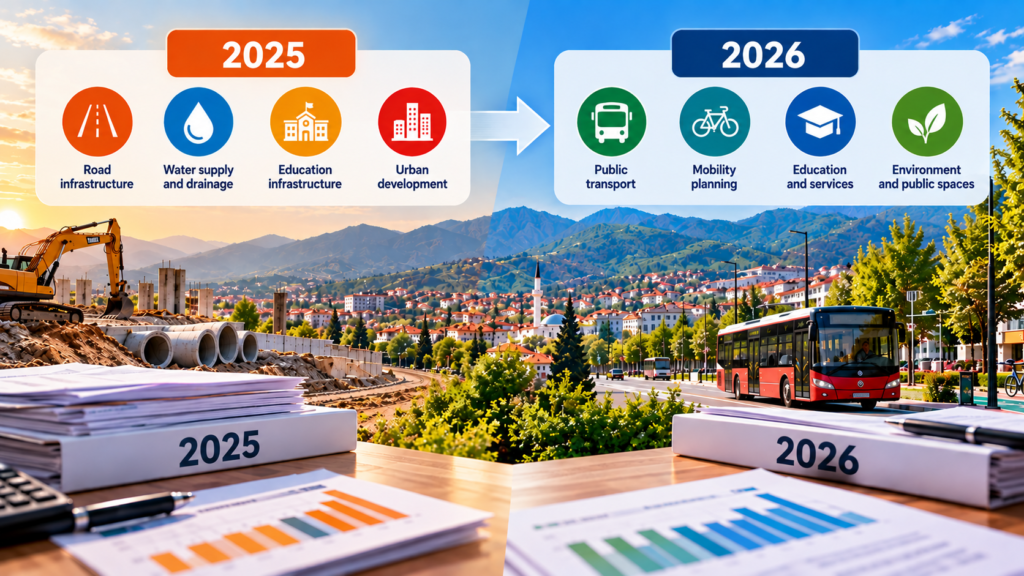
If a municipality’s budget is viewed as a map of its priorities, a comparison between 2025 and 2026 reveals that Tetovo has not completely changed course; rather, it is shifting some of its focus from infrastructure construction to how that infrastructure is utilized and functions in daily life.
Infrastructure continues to represent a significant portion of the municipality’s priorities. In the 2025 budget, the Municipality of Tetovo planned for approximately €48.5 million, with about €16.5 million allocated for capital investments. According to MIA, these funds included around €11.5 million from the Hungarian loan. Listed projects included road infrastructure, stormwater drainage systems, water supply improvements, and investments in school facilities.
For 2026, a budget of approximately €44.7 million has been adopted. According to Alsat, more than €17 million is earmarked for capital investments. While the amount allocated for capital investments is higher, this does not automatically mean the Municipality has more total funds at its disposal. Budget comparisons must be made carefully, as financing structures and external funding sources vary from year to year. The Municipality’s own documents show that investments in roads, water supply, sewage systems, schools, and urban projects remain the focus for 2026. The budget and programs for 2026 have been published in the official documents of the Municipality of Tetovo.
Consequently, if anyone expected 2026 to bring a complete departure from the established model, the figures do not bear this out. Construction and capital investments remain central to municipal policy. The difference is more evident in the types of services being built upon this infrastructure.
One of the most visible examples is public transport. At the end of 2025, the Tetovo Municipal Council adopted a decision to provide free public transport for primary and secondary school students. The distribution of RFID cards began in early 2026. According to SDK, the measure covered approximately 14,500 students.
For a family, this is a tangible measure that can reduce monthly expenses. For a young person, the significance is broader; public transport determines the ease with which they can reach school, sports activities, the city center, or cultural events.
However, there is a distinction here between the political promise and its practical implementation. During the campaign, free public transport was presented as a measure with a broader scope. In practice, however, it did not become universal; Portalb reported that free transport applies to students and specific categories based on criteria established by the Municipality.
This does not negate the measure’s importance for students, but it highlights a discrepancy between the initial political message and the implemented model. Furthermore, students from the two universities in Tetovo were not included in the initial scheme in the same way, a particularly relevant point for a city with a large student population.
In June, the Municipality took another step by introducing a free transport line for residents of Brodec, Veshala, and Bozovce. Portalb reported that the line aims to connect these mountain settlements with Tetovo.
In addition to public transport, a step toward long-term urban transport planning was taken with the Mobility Plan 2026–2036. According to Koha, the document spanning approximately 120 pages analyzes traffic-related issues in Tetovo and proposes measures regarding parking, the street network, boulevard expansion, and alternative modes of transport. The plan itself identifies the rising number of vehicles, pollution, a lack of infrastructure for pedestrians and cyclists, and the strain on the street network as some of the problems facing the city.
This represents a shift in the planning approach rather than in the results achieved so far. Tetovo now has a document addressing urban transport over a ten-year period, yet the question remains as to how many of the proposed measures will actually be transformed into concrete, funded projects.
Water supply and sewage issues also remain among the major, long-term investments. These projects typically lack the visibility of constructing a new boulevard, yet their impact on the city is significant.
The wastewater infrastructure project entails the construction of a treatment plant with a capacity of 95,152 population equivalents. According to IRD Engineering, the project aims to expand sewage infrastructure coverage and address the issue of uncontrolled wastewater discharge into watercourses.
While significant, these investments also highlight a long-standing issue in Tetovo: a substantial portion of funds is still being directed toward resolving basic infrastructure deficiencies. For a city aspiring to position itself as a modern urban center, the fact that water supply and sewage remain among the primary capital projects indicates that the fundamental infrastructure is not yet fully consolidated.
In the education sector, the approach differs somewhat. Rather than limiting the discussion solely to the construction of facilities, the Municipality has adopted an Education Development Strategy for 2025-2030. The Municipality of Tetovo’s Education Development Strategy 2025-2030 has been published in the Municipality’s official documents. It envisages, among other things, the construction and modernization of school facilities, investments in sports facilities, and the creation of conditions for single-shift schooling.
TV21/TV-Shenja reported on the strategy’s objectives, which include new school facilities, indoor swimming pools, sports halls, and the expansion of certain schools.
However, there is a discrepancy here between the strategic document and the reality on the ground. In September 2026, Portalb reported that smoke detectors planned for school restrooms had not yet been installed, and the deadline had been extended to 2027. While this example is relatively minor in terms of the total budget, it illustrates a broader issue: not every announced measure reaches the public at the same pace.
An even more significant example is the theater and library project. Construction on the project has entered its twelfth year, and according to data published by Koha, physical completion stood at approximately 31.5 percent by the end of 2025. New funds were allocated for 2026, but statements regarding the project indicate that they were insufficient for its completion.
This project serves as a key example of how public investment policies should be interpreted. A municipality may list a large number of projects, but the number of planned projects is not the same as the number of completed ones. For the citizen, the most important thing is for the investment to be finalized and the facility to be put into use. In this sense, 2026 cannot simply be described as a year of a complete shift in priorities. More precisely, it is a year in which infrastructure priorities from the previous period continue, while new policies regarding public transport, mobility, and public services are introduced in parallel.
For young people, change is measured more by services than by millions of euros
For a young person in Tetovo, a budget of 44 or 48 million euros is an abstract figure. What matters is what actually changes in everyday life.
Free transport for students is a tangible change. The mobility plan could be significant if it creates more space for pedestrians and cyclists. The education strategy could have an impact if it translates into functional schools and better conditions. Investments in the sewage system may not be visible in photographs, but they are essential for a city aiming to resolve its environmental issues.
At the same time, there are reasons for caution when using the term “development.” A large budget does not automatically equate to significant development. This is evidenced by the history of projects that are planned for years yet implemented slowly.
Another important point is that capital investments represent only one part of the budget. A significant portion of municipal funds goes toward operating expenses, salaries, services, and other obligations. Therefore, the value of a budget cannot be measured solely by the cost of announced projects.
Ultimately, the difference between 2025 and 2026 looks more like a partial shift than a complete turnaround. Tetovo is continuing with a strong infrastructure agenda but is now attempting to complement it with policies more directly linked to the city’s day-to-day functioning. The responsibility no longer lies merely in setting priorities; those are already enshrined in budgets, strategies, and plans.
The real test is implementation. Will the projects be completed within the scheduled timeframes? Will the new services operate sustainably? Will students and young people currently excluded from existing schemes gain greater access to public services? And will Tetovo, in a few years’ time, be a city with better living conditions, or simply a city with more projects listed in official documents?
The answer will not be found in the adopted budget. It will be revealed by what is actually completed and functional on the ground.
Author: Angel Stojanovski

This activity is supported by the CIVICUS Digital Democracy Initiative (DDI)