


The property tax we pay, along with local fees and other charges, is part of the funds the Municipality of Tetovo uses to finance its operations and public services. But how much revenue does the Municipality collect, where does it come from, and where does it go?
When discussing municipal finances, it is important to distinguish between the revenue the Municipality collects itself and funds coming from other sources, such as central government transfers, donations, and grants.
According to the official 2026 Budget of the Municipality of Tetovo, total projected revenue amounts to 2,749,527,606 denars. Of this amount, 325,062,703 denars are projected as tax revenue.
This means that tax revenue accounts for approximately 11.8% of the total revenue shown in the 2026 budget.
Where do tax revenues come from?
The majority of the Municipality of Tetovo’s tax revenue is derived from property taxes.
For 2026, 178,737,618 denars are projected from property taxes, while 43,703,306 denars are projected from taxes on income, profits, and capital gains, and 102,621,781 denars from taxes on specific services. In total, these categories amount to 325,062,703 denars. These figures are part of the Municipality of Tetovo’s official revenue statement.
This means that more than half of the projected tax revenue for 2026 comes from property taxes.
Property tax is one of the primary local obligations for citizens and business entities. The municipality also provides financial forms and services related to taxes, including declarations for property tax assessment and declarations regarding the transfer, gifting, or inheritance of real estate.
But where does this money go?
It is important to understand that the tax paid by a citizen is not directly linked to any single specific project.
Once collected, these revenues become part of the municipal budget and are subsequently used – alongside other funding sources—to support programs and services under the Municipality’s jurisdiction.
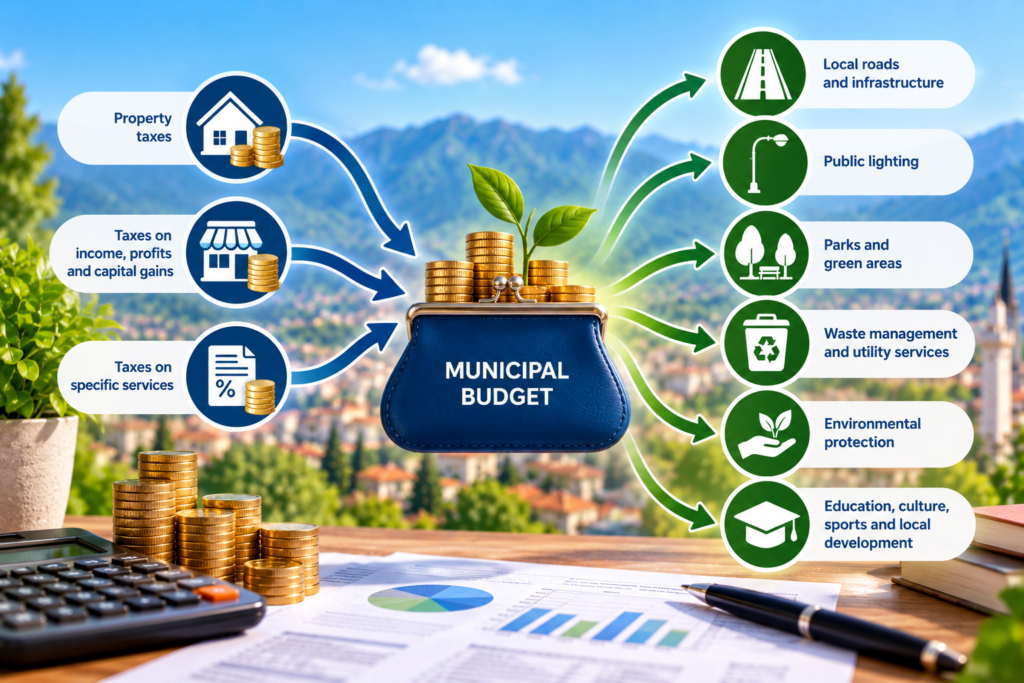
These include the maintenance and construction of local roads, public lighting, the upkeep of public spaces, parks, and green areas, waste management, utility services, environmental protection, urban planning, and other local activities. Depending on its competencies and funding structure, the municipal budget also supports areas such as education, culture, sports, and local development.
The Municipality of Tetovo itself has dedicated units for budget coordination and control that monitor budget execution, contracts, obligations, and expenditures.
Is the municipality funded solely by taxes?
No.
This is one of the most important things to understand when reading a municipal budget.
In 2026, in addition to 325 million denars in tax revenue, the budget includes non-tax and capital revenues, as well as transfers and donations. Regarding transfers and donations alone, the official document projects total revenues exceeding 2.3 billion denars in this category.
Therefore, when we see a municipal investment of several million denars, we cannot automatically assume it is funded solely by the taxes paid by citizens.
To understand where the money goes, we need to track the source of funding, the budget line item, and the actual expenditure.
How successfully are taxes being collected?
There is an interesting piece of data from 2025.
In March 2026, MIA reported that, according to the Mayor of Tetovo, property tax revenues collected in 2025 exceeded the projected amount by approximately 20%. According to his statement, 120% of the projected revenue from this source was realized.
This is a positive indicator regarding the collection of own-source revenues. However, an important distinction must be made: collecting funds is not the same as spending them.
If the Municipality collected more tax revenue than planned, the next question is: how much of those funds was spent, and on what?
What should the citizen see?
For a citizen, knowing the amount of tax to be paid is not enough.
They need to be able to track the flow of funds: how much was planned to be collected, how much was actually collected, under which budget item the funds were recorded, how much was spent, and what specific result was achieved.
Therefore, budget transparency does not end with the publication of a document containing figures.
The Tetovo Municipality Council adopts the budget and the annual financial statement, and the Municipality notes that the Council also approves reports on budget execution.
Thus, the citizen faces two distinct questions:
How much money was planned?
And
How much money was actually spent?
The difference between these two figures is often the most important part of the story regarding public finances.
Where does my money go?
The short answer is: revenue from local taxes goes into the Municipality’s budget and, alongside other funding sources, is used for public services, programs, and investments.
For 2026, the Municipality of Tetovo has projected tax revenues of 325,062,703 denars, with 178,737,618 denars coming from property taxes.
However, the most important question for the citizen is not merely:
“How much did the Municipality collect?”
But rather:
“How much of this money was translated into tangible services and investments for the citizens?”
Public transparency is precisely what enables us to verify this.
Author: Angel Stojanovski

This activity is supported by the CIVICUS Digital Democracy Initiative (DDI)