

From overflowing dumpsters and a lack of space to the responsibility of citizens and institutions
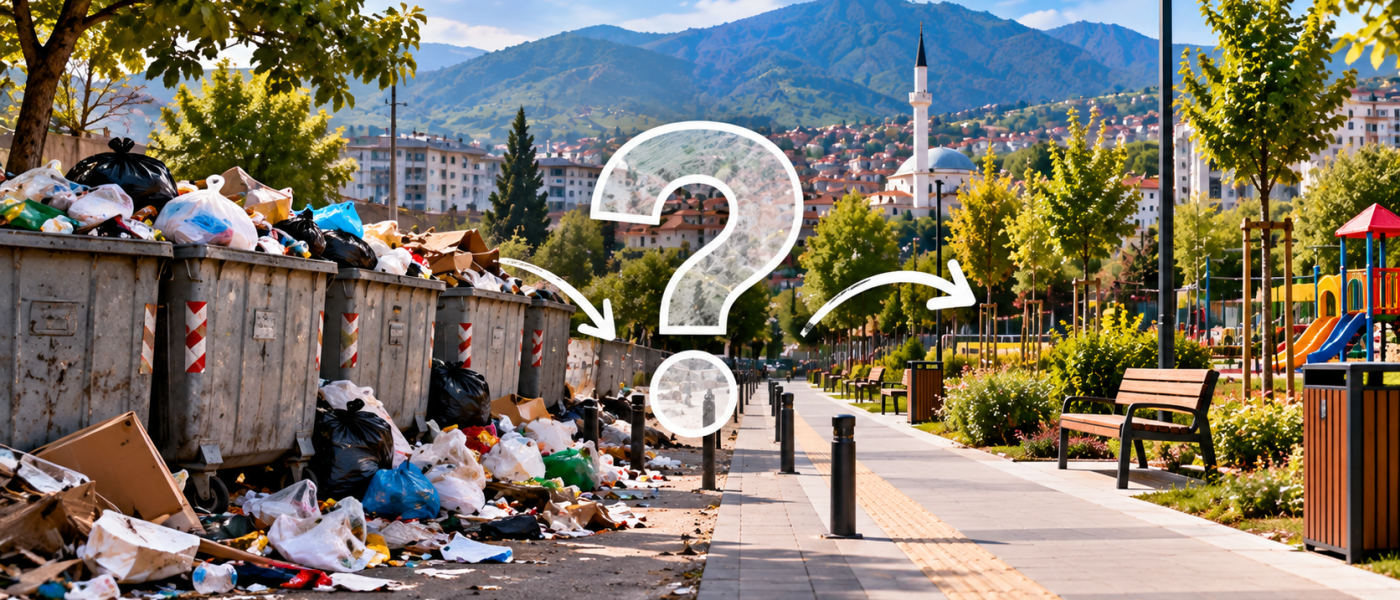
A city’s cleanliness usually goes unnoticed when the system is functioning properly. It becomes noticeable when dumpsters overflow, waste piles up around them, sidewalks are blocked, green spaces are neglected, or public areas become difficult to navigate after rainfall.
In Tetovo, these issues are nothing new. Throughout 2026, several initiatives have been launched to improve public sanitation, waste collection, the maintenance of public areas, and the regulation of public space usage. Yet, beyond these sporadic efforts, a broader question remains: does Tetovo possess a sufficiently efficient and sustainable system for maintaining the city’s cleanliness?
Formally, responsibilities are divided among various institutions and companies. The Municipality of Tetovo states on its official website that municipal services encompass public sanitation, the collection and transport of municipal waste, and the maintenance of parks, greenery, public parking lots, local streets, and other public areas.
The Public Utility Company “Tetova” is responsible for some of these services. Its official website lists services such as the cleaning and maintenance of public areas, as well as the upkeep of parks, urban greenery, and public green spaces.
Saubermacher Tetovo also plays a significant role in municipal waste management. The Municipality of Tetovo states that Saubermacher has been contracted to collect and dispose of municipal waste at the Rusino regional landfill.
This division of responsibilities is important because when a citizen sees an overflowing dumpster or waste left in a public area, the underlying cause is not always the same. Waste collection is one task, street sweeping and washing is another, green space maintenance is a third, and the monitoring and sanctioning of those who misuse public space is a fourth.
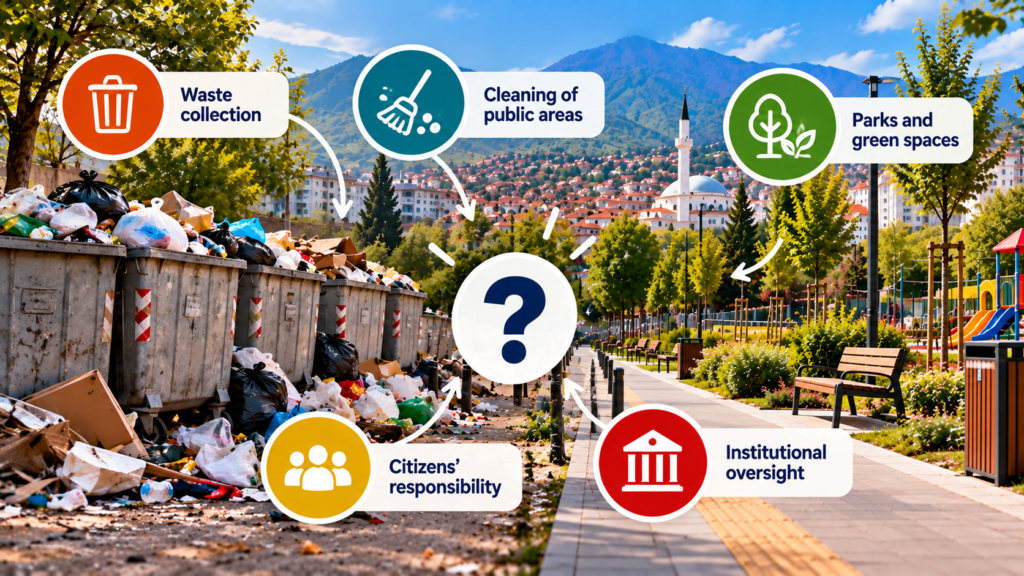
This is precisely where one of the main problems arises: citizens see the end result, whereas the institutions are divided according to their specific areas of jurisdiction.
Waste dumpsters remain one of the most visible problems in Tetovo. In many parts of the city, waste is not removed quickly enough, causing dumpsters to remain full for extended periods. Once capacity is exceeded, waste begins to accumulate around them, turning a municipal waste issue into a public hygiene problem.
However, the cause cannot automatically be attributed solely to irregular collection.
Tetovo is a city with a large population, a significant student body, and a high volume of daily commuters from surrounding areas. In certain parts of the city, the volume of waste generated is substantial, yet the number and capacity of the dumpsters do not always appear sufficient to meet actual needs. If a specific location has a high population and generates significant waste, yet dumpster capacity remains unchanged, overflowing bins become an expected outcome.
There is also an issue regarding collection schedules. Even when dumpsters are emptied regularly according to a set timetable, that schedule may prove inadequate for the busiest locations. A system that works well in a less busy part of the city is not necessarily sufficient for a densely populated street.
In September 2026, the public utility company “Tetovo” launched an initiative to wash the dumpsters and clean the surrounding areas. According to Ora24, the operation took place during the evening hours and targeted locations where waste accumulation around the dumpsters was most frequent.
The utility company also urged citizens to dispose of waste inside the dumpsters rather than around them and to refrain from leaving inert waste near the bins.
This appeal is well-founded, as improper citizen behavior is part of the problem. Waste left beside dumpsters, even when there is available space inside, and the mixing of different types of waste are common sights in the city. A particular issue is the dumping of bulky waste, construction materials, and other refuse in areas not designated for such purposes.
However, one should look beyond the simplistic explanation that “the citizens are to blame.”
If dumpsters are overflowing, if their numbers do not match the population size, or if collection is infrequent, then the system itself bears some responsibility.
On the other hand, if there is space available in the dumpster yet waste is deliberately left on the ground beside it, the problem clearly cannot be solved simply by adding more dumpsters.
This brings us to the third aspect of the issue: institutional oversight.
If citizens know that improper waste disposal almost never results in sanctions, then the penalty ceases to be a genuine part of the system and remains merely a theoretical possibility. Yet, sanctions alone are not the solution if citizens lack sufficient dumpsters, organized collection services, or clear options for the proper disposal of various types of waste.
Therefore, the problem of overflowing waste containers cannot be solved by a single measure. It requires a combination of a sufficient number of containers placed appropriately, more frequent waste collection at the busiest locations, clear rules regarding different types of waste, and effective inspection and enforcement.
It is particularly important for institutions to take action against citizens and entities that repeatedly dispose of waste improperly. Without oversight and tangible sanctions, appeals for responsible behavior have limited effect.
However, sanctions make sense only if citizens have a realistic and accessible alternative for proper waste disposal.
The question, therefore, is not merely “who dumped the waste?” but also “does the system enable citizens to dispose of waste correctly, and do institutions take action when someone knowingly violates the rules?”
The answers to these two questions are crucial to understanding why the waste problem in Tetovo keeps recurring.
Beyond the containers themselves, the way waste is handled after collection is also a significant part of the problem. In 2025, a pilot project for waste sorting was launched in the Tetovchanka neighborhood. According to published information, the first phase involved placing containers for the separate collection of plastic, paper, and mixed municipal waste at 19 public locations.
Individual bins for different types of waste were also provided for households in the neighborhood.
This represents a step beyond the traditional model where all waste is discarded into a single container. However, the true test of such a system is not the number of bins installed, but whether citizens actually sort their waste and whether it is subsequently collected and processed appropriately.
In a broader regional context, Tetovo and the Polog region continue to face serious waste management challenges. State institutions announced the modernization of the regional waste management system linked to Rusino for 2026. MIA reported on the procurement of machinery and the measures to modernize the regional system.
This is important because cleanliness in Tetovo does not end at the waste container. Waste must be collected, transported, and properly landfilled or processed. If one part of the system fails to function, the problem is passed on to the next stage.
Physical obstructions on sidewalks also pose a problem for public spaces. In August 2026, the Municipal Inspectorate carried out operations to clear sidewalks of products and equipment that impede pedestrian movement. Koha reported that inspection services are seizing goods and equipment from certain locations that are blocking sidewalks, particularly along Ilinden Boulevard.
This is not merely a matter of urban order. When a sidewalk is blocked, pedestrians are often forced to walk on the roadway. For schoolchildren, university students, and citizens who walk through the city daily, this directly impacts safety and accessibility.
Yet, the issue of continuity remains. If sidewalks are re-occupied after a single inspection drive, the problem has not been permanently resolved. What is needed is continuous monitoring, clear regulations, and the consistent application of rules for everyone.
A similar issue arises with construction activities. In April 2026, Koha reported that the Municipal Inspectorate had taken action against construction companies for polluting streets and public areas. According to the report, companies were required to remove the debris and dirt caused by their operations, including by washing the streets.
This example demonstrates that maintaining public cleanliness does not depend solely on municipal utility companies and citizens. Construction companies, hospitality venues, shops, and other entities that utilize public space also bear responsibilities.
A clean city is not created through sporadic campaigns alone
It is easiest to reduce the cleanliness issue in Tetovo to a single explanation: either citizens lack responsibility, or institutions are not doing enough. The reality, however, is more complex. When dumpsters are overflowing, the problem may stem from insufficient capacity or infrequent collection. When waste is left beside an empty dumpster, the responsibility lies primarily with the person who left it there. When a sidewalk is obstructed, the inspection authorities have a duty to intervene. When sanctions are virtually non-existent, the system fosters conditions that allow the same behavior to recur.
Therefore, the maintenance of public spaces should be viewed as a system rather than a series of isolated actions.
What is needed is a sufficient number of dumpsters in appropriate locations, regular and more frequent collection in high-load areas, options for the proper disposal of bulky and other specific types of waste, waste sorting and recycling, regular maintenance of streets and green areas, and, crucially, inspection mechanisms that actually work.
At the same time, citizens must also bear clear responsibility. Public spaces cannot remain clean if a portion of the population continues to use the area around dumpsters as an illegal dumping ground.
However, to expect responsible behavior, a functional alternative must exist. Citizens cannot be expected to sort their waste if there are not enough sorting bins. Proper disposal of bulky waste cannot be expected if citizens lack a clear and accessible collection service for it. That is precisely why the main question for Tetovo in this area is not merely how many cleanup drives will be carried out throughout the year.
The question is whether the city can establish a system where dumpsters do not regularly overflow, waste does not sit in public areas for days, citizens have the means to dispose of waste properly, and those who deliberately violate the rules are identified and sanctioned.
For young people, public space is more than just streets and dumpsters. It encompasses the routes they take to school and university, the places where they spend time with friends, parks, squares, sidewalks, and green areas.
Therefore, the quality of public space is also a matter of quality of life.
Several concrete activities are planned for 2026: washing and cleaning around dumpsters, a pilot waste-sorting program, inspection drives to clear sidewalks, and a greater regional focus on waste management.
Yet, the ultimate test remains: will these activities become part of a regular system, or will they remain sporadic interventions repeated only when the problem becomes visible again?
For a city with a large population and intense daily activity, cleanliness cannot rely solely on appeals to citizens or occasional cleanup drives. What is needed is a reliable waste management service with sufficient capacity, an adequate number of dumpsters, clear rules, a functional waste system, continuous inspections, and realistic sanctions, but also greater responsibility on the part of the citizens themselves.
Ultimately, the quality of a city is not measured solely by new buildings, boulevards, and major capital investments. It is also reflected in the most ordinary things: whether the dumpster is emptied when it should be, whether there is space for pedestrians, whether parks are well-maintained, and whether public space truly belongs to everyone.
It is precisely in these everyday details that citizens most directly experience the functioning, or malfunctioning, of local government.
Author: Angel Stojanovski

This activity is supported by the CIVICUS Digital Democracy Initiative (DDI)