


Local government transparency is not measured solely by the number of published documents. It entails citizens receiving information in a timely manner, understanding how public funds are spent, and participating in decision-making. The 2026 Openness Index, prepared by the Metamorphosis Foundation and the Rural Coalition, provides a basis for examining these issues within the Municipality of Tetovo as well.
What do the national data show?
The research conducted from February 1 to June 30, 2026, found an average openness level of 39%, compared to 40% in 2025. Only 15 out of 81 local self-government units achieved a score above 50%. This indicates a need for continuous improvement in the provision of information and accountability.
| Year | Average openness |
| 2025 | 40% |
| 2026 | 39% |
Tetovo in the context of the Polog Region
According to the presented results, the Polog Region has the lowest level of openness among the planning regions. In this context, the assessment of Tetovo is particularly significant, given its role as the region’s urban center. However, Tetovo’s specific result is not confirmed in the sources used; therefore, we do not attribute an unverified percentage or rank to it.
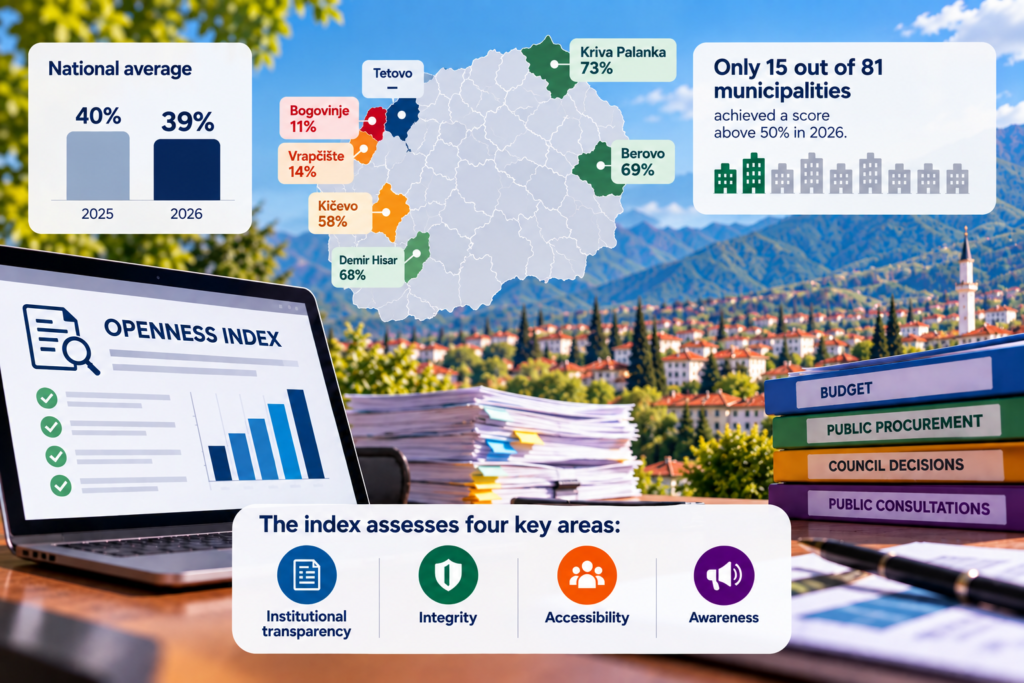
The nearby municipalities of Bogovinje (11%) and Vrapčište (14%) show low results, whereas Kičevo reaches 58%. At the national level, Kriva Palanka scores 73%, Berovo 69%, and Demir Hisar 68%. These disparities demonstrate that institutional openness is not predetermined by a municipality’s size or geographical location.
| Municipality / reference | Index 2026 |
| Kriva Palanka | 73% |
| Berovo | 69% |
| Demir Hisar | 68% |
| Kichevo | 58% |
| National average | 39% |
| Vrapchiste | 14% |
| Bogovinje | 11% |
| Tetovo | The individual result has not been confirmed. |
What needs to be analyzed in Tetovo?
The index covers institutional transparency, integrity, accessibility, and awareness. For Tetovo, the local analysis needs to determine whether the budget, financial reports, public procurement data, and the Council’s agenda and decisions are regularly published in searchable formats and in the official languages. It is equally important to assess whether public consultations are held prior to decision-making and whether the municipality publishes responses to citizens’ proposals.
The practices of municipalities with higher scores offer opportunities for comparison, though not automatic solutions. The September forum discussed the regular updating of municipal websites, budget consultations, and digital communication channels. Tetovo could consider these practices and adapt them to the needs of its residents.
From documents to civic participation
The efforts of the Civil Alliance for Development to bring local documents and decisions closer to young people through digital tools and artificial intelligence can complement institutional transparency. However, any such tool relies on the municipality itself publishing accurate, complete, and up-to-date data. True openness means that a citizen can not only read a decision but also ask questions and participate in the process prior to its adoption.
Conclusion
For Tetovo, the Openness Index 2026 should serve as an impetus for the measurable monitoring of documents, information services, and public consultations. Comparisons with other municipalities are valuable when translated into concrete steps, and progress is documented through verifiable data.
Sources
- What municipalities in the RMV try to hide from citizens reveals the Openness Index
- Openness Index 2026: No significant progress in the transparency of municipalities in the Republic of Macedonia towards citizens
- Openness Index 2026: No significant progress in the openness of municipalities towards their citizens
- From An Open Municipality To An Active Community
Author: Angel Stojanovski

This activity is supported by the CIVICUS Digital Democracy Initiative (DDI)