

From subsidies for inverter air conditioners and bicycles to the development of a Local Environmental Action Plan, a green cadastre, and measures for cleaner air, here is what the Municipality of Tetovo’s program entails, the planned funding, and what has been achieved so far.
The Municipality of Tetovo has adopted the Program of Activities for Environmental and Nature Protection for 2026. The program was adopted by the Tetovo Municipal Council on December 30, 2025, and published in the “Official Gazette of the Municipality of Tetovo” (No. 24) on December 31, 2025.
The document outlines the measures the Municipality plans to implement regarding air, water, soil, waste, noise, nature, biodiversity, climate change, and other areas related to environmental protection.
In a city like Tetovo, where air pollution remains one of the most visible environmental issues, the 2026 program holds particular significance.
How much funding is planned?
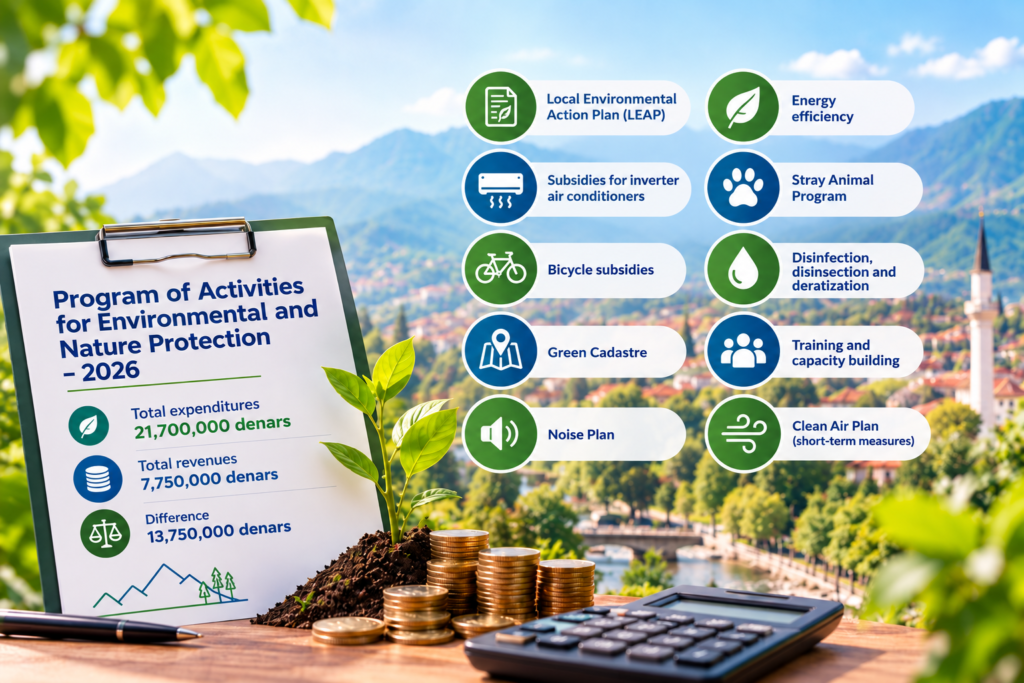
According to the official program, 21.7 million denars in expenditure are allocated for activities related to environmental and nature protection.
On the other hand, the program projects revenues of 7.75 million denars, resulting in a difference of 13.75 million denars.
Considering only the planned expenditure, this amounts to approximately 352,000 euros, based on an indicative exchange rate of 61.5 denars per euro.
The funds are not concentrated in a single measure but are distributed across several activities.
The program in figures
| Activity | Planned amount |
| Preparation of a Local Environmental Action Plan – LEAP | 6,150,000 denars |
| Subsidies for inverter air conditioners | 6.500.000 denars |
| Subsidies for bicycles | 1.250.000 denars |
| Green Cadastre | 1.000.000 denars |
| Noise Plan | 500.000 denars |
| Technical documentation for B-integrated environmental permits | 600.000 denars |
| Energy Efficiency Program | 600.000 denars |
| Training and capacity building for the sector | 1.000.000 denars |
| Homeless Animal Program | 2.500.000 denars |
| Disinfection, disinsection, and deratization | 900.000 denars |
| Action plan with short-term measures for clean air | 600.000 denars |
| Total | 21.700.000 denars |
All these amounts are listed in the official Program of the Municipality of Tetovo for 2026.
6.5 million denars for inverter air conditioners – but where is the implementation?
One of the most concrete measures is subsidizing citizens for the purchase of inverter air conditioners.
The municipality has allocated 6.5 million denars for this measure. The program entails issuing a public call, citizen applications, document verification, on-site inspections, and the disbursement of subsidies.
However, this is precisely where a significant discrepancy arises between what was planned and what was actually implemented.
According to monitoring conducted by the Electoral Reform Support Program, by the end of the April-June 2026 period, no public announcement regarding this measure had been identified, the application process had not commenced, no beneficiaries had been selected, and no subsidy payments had been recorded.
The monitoring also found no evidence of public procurement procedures related to this measure.
Furthermore, the monitoring highlights ambiguities regarding the budgetary allocation of funds: while the program earmarks 6.5 million denars for inverter air conditioners, the budget plan lists an amount of 1.5 million denars under the general environmental protection category, without clearly specifying the source of the full funding required for the inverter air conditioner subsidies. So, in this case, we have a specific example where an activity is listed in the annual program with a designated amount, yet its practical implementation had not been recorded by the end of the second quarter.
Important: state vouchers are not the same as the municipal measure
State vouchers for inverter air conditioners were also issued during 2026; however, this is a measure implemented by the Ministry of Energy and should not be considered the implementation of the municipality’s 6.5-million-denar program.
In March 2026, for instance, it was announced that 2,084 of the total 4,070 awarded vouchers had been claimed at the national level.
Therefore, these two measures should be treated separately: the state vouchers do not constitute proof that the Municipality of Tetovo has implemented its planned subsidy of 6.5 million denars.
1.25 million denars for bicycles – no implementation by August
Another measure within the Environmental Program involves subsidizing citizens for the purchase of bicycles, with 1.25 million denars allocated for this purpose.
Here, too, monitoring data reveal a gap between the plan and its implementation.
In August 2026, “Portalb” reported that the Municipality of Tetovo had not yet implemented the bicycle subsidy scheme.
According to the monitoring findings, no public call, criteria, list of required documents, deadlines, or application procedures for citizens had been announced.
Furthermore, no public procurement processes related to this measure were identified, and it remained unclear how the subsidy payments were to be administered and financed.
The Municipality did not provide an explanation as to why the measure had not been implemented or whether it would be carried out before the end of the year.
This means that, based on publicly available information as of the end of August, the 1.25 million denars allocated for bicycle subsidies had yet to yield any tangible results for citizens.
What has been done in the meantime?
Not all environmental activities remained merely at the planning stage.
In April 2026, the conference “Identifying Environmental Priorities for the Municipality of Tetovo” was held in Tetovo, attended by representatives from the Municipality, the Ministry of Environment, experts, and civil society.
The event addressed Tetovo’s environmental issues as well as future policies and activities related to the green transition process.
During the discussions, a proposal was also made to establish a separate department for environment and energy within the Municipality of Tetovo.
This is significant because strengthening institutional capacity in the fields of environment and energy is part of the broader priorities of the program for the 2025-2029 term.
However, a conference, consultation, or working meeting should not automatically be equated with the implementation of a concrete budgetary measure. That requires tangible results, such as documents, contracts, procurements, investments, or completed activities.
The energy efficiency program is under preparation
Another development planned for 2026 is the preparation of an energy efficiency program for the 2026-2029 period.
The Municipality’s documentation outlines plans to hold a public debate, prepare the 2026–2029 Energy Efficiency Program, create an electronic database for analyzing costs associated with municipal buildings, and prepare technical documentation for the facilities where energy efficiency measures would be implemented.
A total value of 1.64 million denars has been allocated for this project.
This demonstrates that in 2026, the Municipality is focusing not only on subsidies for citizens but also on establishing a broader foundation for reducing energy consumption in public buildings.
However, a distinction must be made between preparing a program and implementing specific measures. The documents pertain to the preparation of the program, the electronic database, and the technical documentation, rather than to completed energy-related interventions in specific buildings.
Green Cadastre – 1 million denars
The 2026 program allocates 1 million denars for the creation of a green cadastre.
Such a cadastre could serve as a vital tool for managing the city’s green areas, as it would enable the inventory and planning of green spaces, trees, and public greenery.
Its practical value to citizens would be significantly greater if the final result were publicly released and made available as an open digital map of Tetovo’s greenery.
However, publicly available materials provide no clear evidence that the green cadastre – funded with the 1 million denars, has been completed and published as a resource accessible to the public.
Noise Plan
500,000 denars have been allocated for the preparation of a noise plan.
Urban noise often remains overshadowed by air pollution, yet it is also part of environmental protection policies.
Such a plan could help identify problem areas and determine measures to reduce noise from traffic, hospitality establishments, commercial activities, and other sources.
600,000 denars for energy efficiency
The program also allocates 600,000 denars for an energy efficiency program.
This measure is particularly significant when applied to public facilities, schools, and municipal buildings, as reducing energy consumption can yield both financial and environmental benefits.
However, the program document itself does not provide a detailed list of the specific facilities where these interventions will be implemented.
Air quality: the problem the Municipality itself identifies as the biggest one
The Municipality’s program clearly identifies the main problem.
The document states that the primary environmental issue facing Tetovo is poor air quality, specifically the presence of PM10 and PM2.5 particles.
Household heating using old and inefficient appliances is cited as one of the contributing factors.
Data from the official state monitoring system indicate that the problem is not merely a matter of rhetoric. In January 2025, the daily limit value of 50 µg/m³ for PM10 was exceeded on 25 days of the month at the Tetovo monitoring station. On several days, concentrations exceeded 100 µg/m³, and a level of 150.3 µg/m³ was recorded on January 1, 2025.
The Tetovo monitoring station continues to track air quality, including PM10 and PM2.5 levels.
The Ministry has also noted that the previous air quality improvement plan for Tetovo covered the 2017-2021 period, and that a new plan, along with the implementation of measures at the local level, is required.
A measure that raises questions
The program also mentions an “aerosol method” as a measure to reduce air pollution.
The document provides for the procurement of machinery, equipment, and spraying agents, as well as the option to use a mobile monitoring station to track parameters during application.
This aspect warrants special attention, as any air quality measure should be evaluated not only based on whether it is planned, but also on scientific evidence regarding its effectiveness, health impact, and measurable results before and after the intervention.
The program itself includes provisions for monitoring pollutants and tracking results.
Therefore, it would be important for the public to have access to measurements taken before and after the implementation of such interventions.
2.5 million denars for stray animals
The program allocates 2.5 million denars to address the issue of stray animals within the territory of Tetovo.
This matter concerns animal welfare, public safety, and public health.
However, the total amount alone does not indicate what results will be achieved.
A realistic assessment requires data on the number of animals treated, the number of sterilizations, care facilities, and the program’s concrete outcomes.
What is missing from the citizens’ perspective?
The program includes a large number of activities and specific financial amounts. However, the annual program is not the same as an implementation report.
For the citizen, it is not only important to know:
- “How much money is planned?”
but also:
- “How much has been spent?”
- “What has been implemented?”
- “How many citizens received subsidies?”
- “What was the result?”
- “What was the cost per beneficiary?”
- “Which institution or company carried out the activity?”
This is particularly important for measures implemented through public procurement or subsidies.
In the case of subsidies for inverter air conditioners and bicycles, publicly available monitoring during 2026 already reveals a discrepancy between the activities outlined in the program and their actual implementation.
From plan to result
The Municipality of Tetovo has a relatively broad environmental protection program for 2026. It covers air quality, energy, alternative transport, green spaces, noise, stray animals, institutional capacity, and environmental planning.
On paper, the goals are clear.
However, the real test lies in implementation.
As of September 2026, available information indicates that some activities are in the preparation or consultation phase, while no implementation has been recorded for some of the measures most directly affecting citizens, specifically subsidies for inverter air conditioners and bicycles, during the periods covered by public monitoring.
What do the data so far show?
| Measure | Planned | Current situation based on publicly available data |
| Inverter air conditioners | 6,5 million denars | It has not been started by the end of June 2026 |
| Bicycles | 1,25 million denars | It has not been realized until August 2026 |
| Green Cadastre | 1 million denars | No clear public evidence has been found that it has been completed. |
| Energy efficiency | Programme 2026-2029 | In the preparation phase |
| Environmental priorities | Local policies and measures | Conference and consultative process held |
| Wastewater treatment | Collector and wastewater treatment plant | Construction work on the project has still not begun as of April 2026. |
This table does not imply that no other environmental activities have been implemented. It presents only those measures for which sufficient information to assess their status was found in publicly available sources.
From “planned” to “realized”
This demonstrates that transparency in implementation is just as important as transparency in planning.
The municipality has published the plan. The next step is for citizens to clearly see what portion of that plan has been translated into concrete results. This is precisely where the most important question regarding Tetovo’s environmental budget lies.
The annual program may feature sound objectives and significant planned funding. However, for citizens, the real test begins with these questions:
- How much of the 21.7 million denars has been spent so far?
- How many contracts have been concluded?
- How many citizens have received subsidies?
- How many inverter air conditioners have been purchased through the municipal program?
- How many bicycles have been subsidized?
- Has the green cadastre been completed?
- How many trees have been planted?
- Has air quality improved?
and, above all
- Which of these results can the public verify?
In the case of subsidies for inverter air conditioners and bicycles, monitoring data released during 2026 already reveals a significant discrepancy between the measure outlined in the program and its actual implementation on the ground.
This makes transparency regarding implementation just as important as transparency regarding planning.
The municipality has published the plan. The next step is for citizens to be able to clearly see how much of this plan has been translated into concrete results.
Author: Angel Stojanovski

This activity is supported by the CIVICUS Digital Democracy Initiative (DDI)